
⚡ Executive Summary
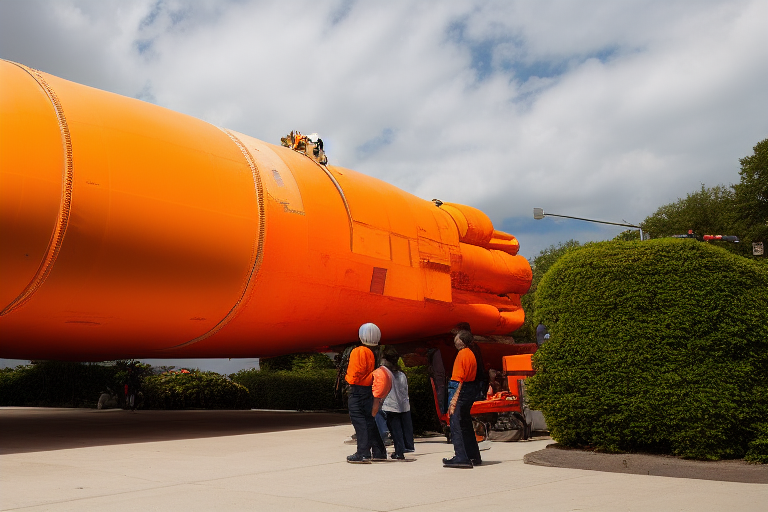
- Core News: An ambitious visual artist has undertaken the monumental challenge of transforming a retired Space Shuttle external fuel tank into a permanent, highly visible public art installation.
- Key Scale/Metric: Measuring over 150 feet in length and weighing tens of thousands of pounds of high-grade aerospace aluminum-lithium alloy, the sculpture represents one of the largest structural art undertakings in industrial history.
- Strategic Impact: This initiative bridges the gap between aerospace heritage and modern public humanities, showcasing how decommissioned space hardware can be culturally revitalized rather than simply scrapped.
Developing News & Core Details
The intersection of aerospace engineering and fine art rarely manifests on a macro-structural scale, but a recent groundbreaking project has successfully bridged these two divergent worlds. By acquiring and modifying a colossal structural component from NASA’s iconic Space Shuttle program—specifically, the massive external propellant tank—an avant-garde artist has pushed the boundaries of industrial sculpture.
The engineering marvel that once housed millions of pounds of liquid hydrogen and liquid oxygen during violent atmospheric ascent is now undergoing a meticulous surface transformation. Unlike typical artistic endeavors working with canvas, digital media, or standard metals, this project deals directly with flight-certified aerospace hardware, requiring specialized techniques to clean, stabilize, and aesthetically coat a structure originally engineered purely for thermal protection and structural load-bearing under extreme aerodynamic stress.
Technical Analysis & Industrial Legacy
To understand the sheer magnitude of this art project, one must examine the engineering pedigree of the Space Shuttle external tank (ET). Manufactured primarily from Al-Li (aluminum-lithium) alloys and insulated with a thick layer of spray-on foam insulation (SOFI), the ET was the only major component of the Space Shuttle stack that was not recovered and reused. Instead, millions of pounds of these colossal structures were discarded into the ocean after every launch, making surviving ground-test units or unlaunched flight articles exceptionally rare and historically significant.
Transforming this industrial artifact required overcoming intense engineering hurdles:
- Material Integrity: The exterior foam, designed to prevent ice buildup and protect against atmospheric heating, degrades over time and requires extensive chemical stripping and stabilization.
- Scale and Logistics: Moving a cylindrical structure over 150 feet long and roughly 27.5 feet in diameter requires aerospace-grade transport logistics, mirroring the original NASA crawlerway movements.
- Structural Modifications: Cutting and anchoring an object designed to withstand immense axial loads demands custom architectural framing to ensure public safety without compromising the aesthetic silhouette.
“Taking a vessel built to punch a hole through Earth’s atmosphere and turning it into a canvas is less about altering the object and more about revealing the sculpture that NASA engineers accidentally designed.”
Industry & Strategic Implications
While this endeavor is fundamentally artistic, it carries deep implications for how society treats space heritage and industrial recycling in the modern commercial space era. As companies like SpaceX, Blue Origin, and Rocket Lab pioneer rapid reusability, the conversation around aerospace waste has shifted dramatically.
Historically, space artifacts were either left to burn up in the upper atmosphere or left forgotten in remote desert boneyards. Projects like this external tank transformation signal a growing appreciation for adaptive reuse. By recontextualizing heavy aerospace hardware, cultural institutions and artists are creating tangible touchpoints that inspire the next generation of engineers, scientists, and dreamers.
Final Outlook
As the final touches are applied to this colossal aerospace sculpture, its long-term impact on public spaces becomes increasingly clear. It stands not merely as a relic of a bygone spaceflight epoch, but as a testament to human ingenuity repurposed. In an era dominated by digital abstraction, the sheer physical reality of a Space Shuttle fuel tank turned monumental art piece serves as an enduring reminder of what heavy engineering can achieve—both in the skies and on the ground.
🚀 Custom Web Hosting & AI Automation Solutions
Need enterprise-grade web hosting, custom WordPress architecture, or automated workflow deployment for your business?



