
⚡ Executive Summary
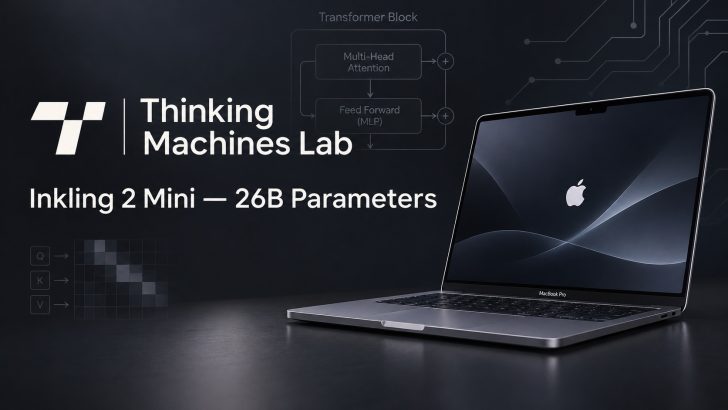
- Core News: Thinking Machines Lab has officially launched Inkling 2 Mini, a 26-billion-parameter open-weight AI model designed for local inference on consumer hardware.
- Key Metric/Data: The model delivers enterprise-grade performance in coding and reasoning tasks while running entirely offline on Apple MacBooks equipped with 32GB of unified memory.
- Strategic Impact: This release marks a pivotal shift from cloud-dependent AI to edge computing, offering users privacy, speed, and reduced latency without sacrificing capability.
Developing News & Core Details
On November 20, Thinking Machines Lab made headlines by unveiling Inkling 2 Mini, a model that defies the traditional trade-off between size and intelligence. While the company’s flagship, Inkling 2 Small, boasts an impressive 594 billion parameters, it requires substantial cloud infrastructure to run effectively. In contrast, Inkling 2 Mini is engineered for accessibility, packing just 26 billion parameters into a package that can execute seamlessly on consumer-grade Apple MacBooks with only 32GB of unified memory.
The announcement highlights a significant evolution in model architecture optimization. Rather than merely truncating the massive parent model to fit smaller constraints, Thinking Machines has employed advanced techniques—likely involving sparse attention mechanisms and highly efficient tokenization—to maintain high reasoning capabilities despite the reduced parameter count. This allows the Mini variant to perform complex agentic workloads, such as multi-step coding tasks and logical problem-solving, without generating excessive tokens or requiring a dedicated GPU cluster.
The ability to run entirely offline is perhaps the most transformative feature. In an era where data privacy concerns are paramount for developers and enterprises alike, having a powerful AI assistant that processes sensitive codebases locally on a MacBook eliminates the latency of network round-trips and mitigates risks associated with cloud data exposure.
Technical Analysis & Competitive Landscape
The emergence of Inkling 2 Mini signals a maturation in the “edge AI” sector. Historically, high-performance models like Llama 3 or Qwen have required significant VRAM to run locally, often necessitating expensive M-series chips with 64GB+ unified memory for optimal performance. Thinking Machines has successfully compressed these capabilities into a 26B parameter model that thrives on 32GB RAM systems.
From an architectural standpoint, the success of Inkling 2 Mini suggests a move toward “dense” efficiency rather than just “sparse” sparsity. While sparse models reduce compute by skipping neurons, dense models like this one likely optimize their internal pathways to maximize information density per parameter. This is critical for agentic workloads, where the model must maintain context over long sequences and execute multi-step reasoning without hallucinating or losing focus.
In the competitive landscape, Inkling 2 Mini positions itself against two main categories of competitors: cloud-based APIs (like OpenAI’s GPT-4o) and other local open-source models. Compared to cloud APIs, it offers lower latency and data sovereignty. Compared to other local models like Llama 3 8B or 70B, it strikes a unique balance—offering more intelligence than the 8B variants while being far more accessible than the 70B versions.
The “open-weight” nature of the model further enhances its appeal. Open weights allow developers to fine-tune the model for specific domains (e.g., legal, medical, or proprietary codebases) without incurring cloud costs per token. This democratization of high-end AI capabilities is reshaping how software development teams approach their toolchains.
Industry & Strategic Implications
The release of Inkling 2 Mini has broader implications for enterprise IT and the consumer tech market. For enterprises, it represents a step toward “bring your own compute” (BYOC) strategies, where companies can deploy AI agents on existing hardware fleets rather than building massive cloud clusters. This reduces OpEx and increases control over data pipelines.
For consumers, particularly developers and creatives using MacBooks, this model lowers the barrier to entry for local LLMs. It means that a professional-grade coding assistant can now run on a standard MacBook Pro without needing an external GPU or cloud subscription. This shift could accelerate the adoption of AI in creative workflows, where real-time interaction and privacy are non-negotiable.
Investors should also note the strategic pivot Thinking Machines is making: from being purely a cloud provider to becoming a hardware-agnostic model provider that optimizes for edge devices. This diversification reduces reliance on fluctuating cloud costs and opens up new revenue streams through licensing, fine-tuning services, or even dedicated hardware partnerships.
“The true breakthrough of Inkling 2 Mini is not just its parameter count, but its ability to deliver enterprise-grade reasoning capabilities on consumer hardware. It proves that the future of AI is moving from the cloud to the edge, where privacy and speed are paramount.”
Final Outlook
Looking ahead, the success of Inkling 2 Mini could set a new benchmark for what constitutes a “viable” local model. If Thinking Machines can continue to refine this architecture, we may see a proliferation of similar models that allow high-end AI to run on laptops and desktops without cloud dependencies.
Future iterations might focus even further on reducing memory footprint or improving inference speed through quantization techniques. The competitive landscape will likely intensify as other labs attempt to replicate this balance between size and capability, potentially leading to a new era of “portable intelligence” where your laptop becomes a powerful AI workstation without needing constant internet access.
In conclusion, Inkling 2 Mini is more than just a smaller version of a larger model; it is a strategic leap forward in making advanced AI accessible, private, and efficient for the everyday user. As we move toward an era where AI agents will manage our workflows autonomously, having these agents running locally on our own machines will be as standard as having a web browser installed today.



