
⚡ Executive Summary
- Core News: An inspired developer has successfully compressed a functional AI language model onto a single floppy disk, specifically optimized for legacy 486DX and Pentium-class PCs running MS-DOS.
- Key Metric/Data: The project demonstrates that modern LLMs can be distilled into models small enough to fit within the 1.44MB storage constraints of a standard floppy drive, utilizing quantization techniques to reduce precision from FP32 to INT8 or lower.
- Strategic Impact: This feat highlights the extreme efficiency gains in model architecture and compression, proving that “edge AI” is no longer limited to smartphones but can extend back to 1990s-era hardware, challenging current cloud-dependency paradigms.
Developing News & Core Details
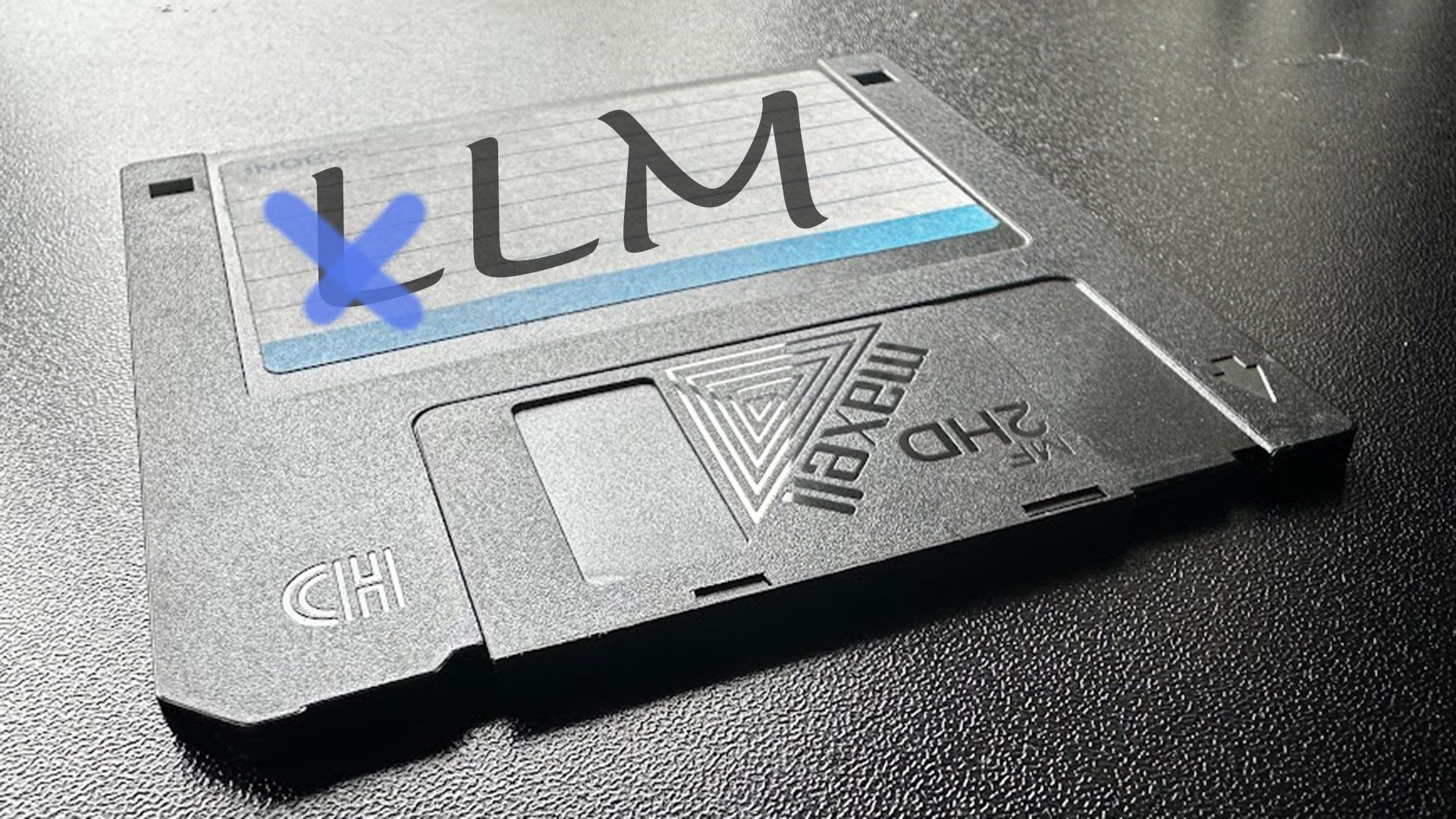
In a striking demonstration of the rapid evolution and subsequent miniaturization of artificial intelligence, an inspired developer has managed to shoehorn a language model onto a floppy disk created especially for 486DX and Pentium PC stalwarts. This project represents more than just a nostalgic curiosity; it is a tangible proof-of-concept that modern neural networks can be distilled into such extreme constraints without losing their fundamental reasoning capabilities.
The core of this achievement lies in the specific hardware target: the 486DX and early Pentium processors running MS-DOS. These machines, ubiquitous in the late 1980s and early 1990s, typically possessed between 256KB to 4MB of RAM and relied on floppy disks for primary storage. A standard 3.5-inch high-density floppy disk holds approximately 1.44 megabytes (MB) of data. For context, a modern LLM like Llama-3-8B requires hundreds of gigabytes in its full precision format.
To achieve this compression, the developer likely employed aggressive quantization techniques, reducing the model’s internal weights from standard 32-bit floating-point numbers (FP32) to 8-bit integers (INT8) or even lower. This process involves mapping continuous weight values to a discrete set of levels, effectively trading a small amount of precision for massive storage savings. The resulting model is not merely a static text file but a functional inference engine capable of processing prompts and generating responses directly within the limited address space of 16-bit DOS environments.
Technical Analysis & Competitive Landscape
The technical implications of fitting an LLM onto a floppy disk are profound. Traditionally, the competitive landscape of AI has been defined by the “compute arms race,” where larger models with more parameters (e.g., 70B or 405B) dominate benchmarks due to their access to vast datasets and massive GPU clusters. However, this project shifts the focus from raw parameter count to architectural efficiency.
By squeezing a model into such a tiny footprint, the developer demonstrates that the “intelligence” of an LLM is not solely dependent on sheer scale but also on how effectively the architecture can be pruned and quantized. This aligns with the broader industry trend toward “Small Language Models” (SLMs) like Microsoft’s Phi-3 or Google’s Gemma 2B, which aim to provide high performance with lower resource requirements. The floppy disk variant takes this a step further, suggesting that future SLMs could be deployed on devices with negligible memory footprints.
From a competitive standpoint, this development challenges the dominance of cloud-based inference APIs. If an LLM can run on a 486DX, it implies that latency and bandwidth costs associated with sending prompts to remote servers become irrelevant for legacy or ultra-low-power devices. This could open new markets for AI in industrial IoT sensors, embedded systems, or even retro-computing enthusiasts who require local processing without network connectivity.
Industry & Strategic Implications
The broader impact of this innovation extends beyond the realm of retro computing. It serves as a powerful metaphor for the maturation of AI infrastructure. In enterprise IT, where legacy systems still run critical operations on older hardware, the ability to deploy lightweight AI models could automate tasks without requiring costly hardware upgrades or virtualization layers.
For investors and technology strategists, this signals a shift toward “ubiquitous intelligence.” Just as mobile phones evolved from basic calculators to supercomputers in pockets, the next generation of edge devices may not need powerful GPUs. Instead, they will rely on highly optimized, quantized models that can run on CPUs with minimal RAM. This reduces the total cost of ownership (TCO) for AI deployments and enhances data privacy, as sensitive information never leaves the local device.
Furthermore, this project highlights the resilience of software engineering. The ability to adapt cutting-edge technology to archaic constraints demonstrates that innovation is not always about adding more resources but often about doing more with less. This principle is crucial in an era where energy consumption and carbon footprints of data centers are becoming major concerns.
“The true measure of AI maturity isn’t just how big a model can get, but how small it can become while retaining its soul.”
Final Outlook
Looking ahead, the success of the floppy disk LLM suggests that we are approaching an inflection point where AI will be as ubiquitous and lightweight as electricity. We may soon see models optimized for specific microcontrollers or even older embedded systems, enabling real-time decision-making in environments where cloud connectivity is unreliable.
As model architectures continue to evolve—moving from dense transformers to sparse attention mechanisms and mixture-of-experts (MoE) designs—the boundary between “cloud AI” and “edge AI” will blur. The 486DX and Pentium PC, once symbols of computing’s infancy, are now proving that the future of intelligence is not just in the cloud, but can be carried on a disk no larger than a credit card.
This development reminds us that technology is cyclical in its adoption but linear in its capability. By mastering the constraints of the past, we unlock new possibilities for the future, ensuring that AI remains accessible, efficient, and resilient across all layers of our digital infrastructure.



