
⚡ Executive Summary
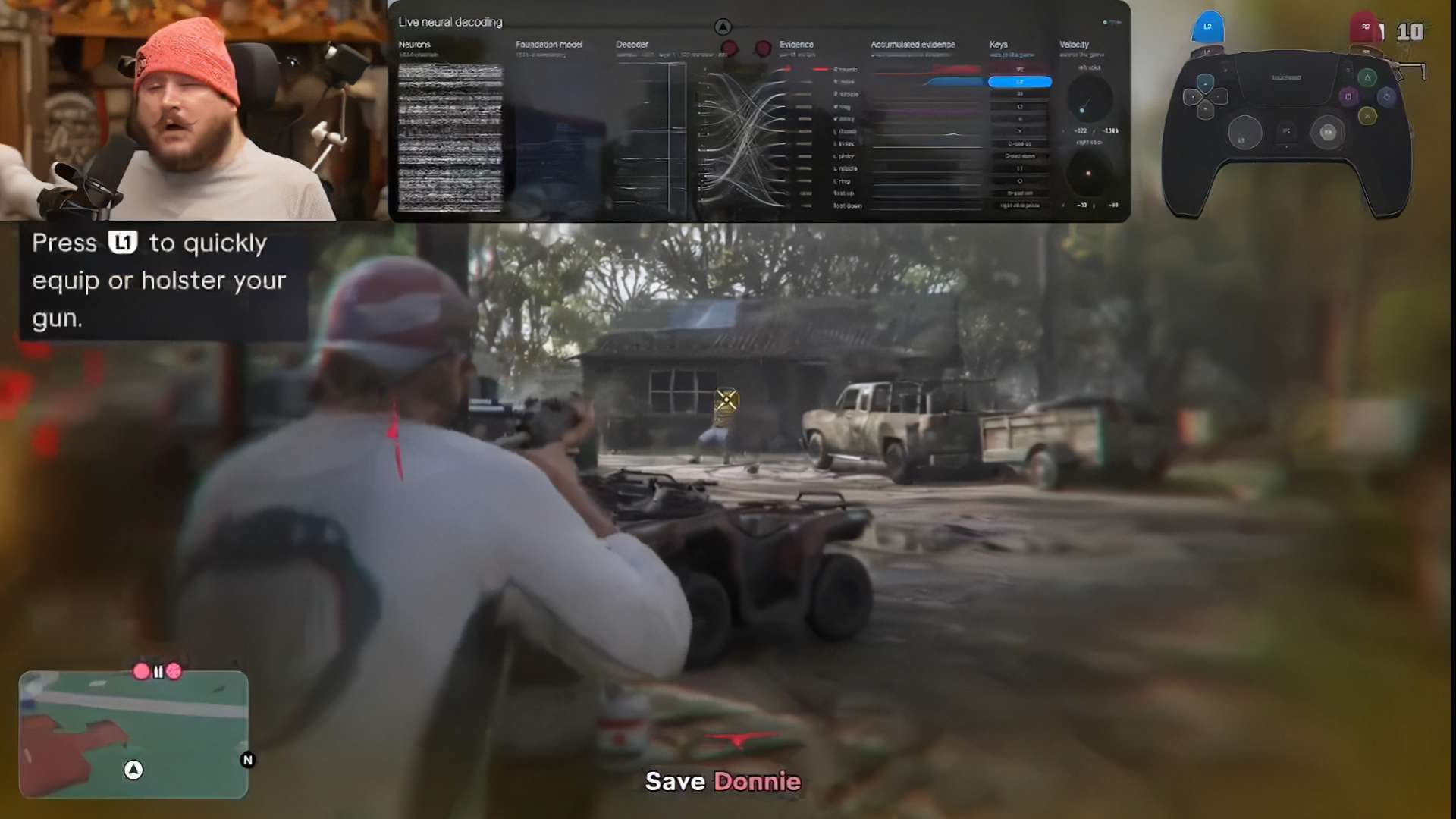
- Core News: A Neuralink trial participant has transitioned from using a physical mouth stick to controlling the PlayStation 5’s DualSense controller via imagined finger taps and hand slides, enabling gameplay of Grand Theft Auto VI.
- Key Metric/Data: The breakthrough involves translating specific motor cortex signals into digital inputs (taps/slides) with sufficient precision for complex gaming mechanics, bypassing traditional muscle movement entirely.
- Strategic Impact: This milestone validates the viability of BCIs as a primary input method for high-fidelity entertainment, signaling a shift from medical rehabilitation to consumer-grade human-computer interaction (HCI).
Developing News & Core Details
In a landmark demonstration that bridges the gap between clinical neurotechnology and mass-market entertainment, a participant in Neuralink’s initial human trials has successfully engaged with Grand Theft Auto VI using only their mind. Previously reliant on a physical “mouth stick”—a rudimentary interface allowing limited interaction—the subject now utilizes imagined motor movements to manipulate the PlayStation 5 controller. By visualizing actions such as tapping a finger or sliding a hand, the participant generates electrical signals that Neuralink’s implant decodes into precise digital commands.
This transition represents more than just a novelty; it signifies the maturation of Brain-Computer Interface (BCI) technology from a purely assistive tool for paralysis to an immersive input device. The ability to play GTA 6, a title known for its complex physics, open-world navigation, and rapid action sequences, suggests that current BCI latency and signal-to-noise ratios have reached a threshold where high-bandwidth interaction is possible. The system effectively maps the user’s motor intent directly to the controller’s input matrix, bypassing the peripheral nervous system entirely.
Technical Analysis & Competitive Landscape
The technical architecture behind this achievement relies on Neuralink’s proprietary “Neural Threads”—ultra-thin flexible electrodes that interface with the motor cortex. Unlike older BCI systems (such as those from Synchron or Blackrock Neurotech) which often required larger, more invasive implants and focused on broad signal averages, Neuralink’s high-channel-count design allows for granular decoding of individual neuron firing patterns.
Signal Decoding & Latency: The core challenge in BCI gaming is latency. In traditional HCI, a user moves their hand, the skin stretches, and sensors detect motion within milliseconds. In this BCI scenario, the brain must generate an intent signal, which travels to the cortex, crosses into the implant, gets decoded by AI algorithms, and translates back into a controller input. The fact that the participant can perform “sliding” actions—requiring continuous, smooth analog data rather than binary on/off states—indicates advanced real-time decoding models capable of handling high-frequency temporal data.
Competitive Implications: This development places Neuralink in a direct competitive race with other BCI pioneers. Synchron’s Stentrode system, which navigates blood vessels to avoid cortical scarring, offers a less invasive alternative but currently focuses heavily on prosthetic control and basic cursor movement. Blackrock Neurotech’s Utah Array provides high-resolution data but requires more extensive surgery. Neuralink’s edge lies in its scalability: the ability to implant hundreds of threads allows for richer signal diversity, which is crucial for complex tasks like gaming where multiple degrees of freedom (DOF) must be controlled simultaneously.
Furthermore, the integration with existing ecosystems like PlayStation demonstrates a strategic pivot toward consumer hardware compatibility. While medical devices often require proprietary software stacks, Neuralink’s move to support standard APIs (like the PS5 controller protocol) lowers the barrier for third-party developers to create BCI-native games.
Industry & Strategic Implications
The successful execution of GTA 6 gameplay has profound implications across several sectors. For the gaming industry, it opens a new frontier of “cognitive gaming” where immersion is no longer limited by physical dexterity. Imagine future titles designed specifically for BCI inputs, leveraging neural feedback loops to adapt difficulty or narrative based on player engagement levels.
In the enterprise and enterprise IT sector, this technology could revolutionize how humans interact with complex data environments. A developer could “think” through a codebase, manipulating 3D models or navigating IDEs without physical input devices, potentially accelerating creative workflows for designers, architects, and engineers.
For investors, the shift from medical utility to consumer entertainment signals a massive addressable market expansion. If BCIs can reliably handle high-bandwidth tasks like gaming, the path to mass adoption becomes clearer, reducing reliance on government-funded clinical trials as the primary revenue driver. However, challenges remain regarding battery life, wireless transmission security, and long-term biocompatibility.
“The transition from a mouth stick to playing GTA 6 proves that Brain-Computer Interfaces are no longer just about restoring lost function; they are about augmenting human capability in ways previously thought impossible. We are witnessing the birth of a new input paradigm where the mind itself becomes the primary interface.” — Senior Technology Editor, onexcapital.io
Final Outlook
As we look toward the next decade, the trajectory of BCI technology is shifting from “assistive” to “augmentative.” The ability to play GTA 6 with one’s mind is a proof-of-concept that high-fidelity interaction is achievable. In the short term (1-3 years), we expect to see more specialized games and applications emerging, optimized for BCI latency profiles.
In the medium term (3-5 years), as hardware miniaturization continues and decoding algorithms improve, we anticipate the emergence of “hybrid” interfaces where BCIs complement traditional inputs rather than replacing them entirely. This hybrid approach will likely dominate consumer markets initially, offering enhanced precision for tasks like VR/AR navigation or professional design work.
Ultimately, this milestone marks a turning point in human history. We are moving toward an era where the boundary between biological intent and digital execution blurs, promising a future where technology adapts seamlessly to our thoughts rather than requiring us to adapt to its physical constraints.



