
⚡ Executive Summary
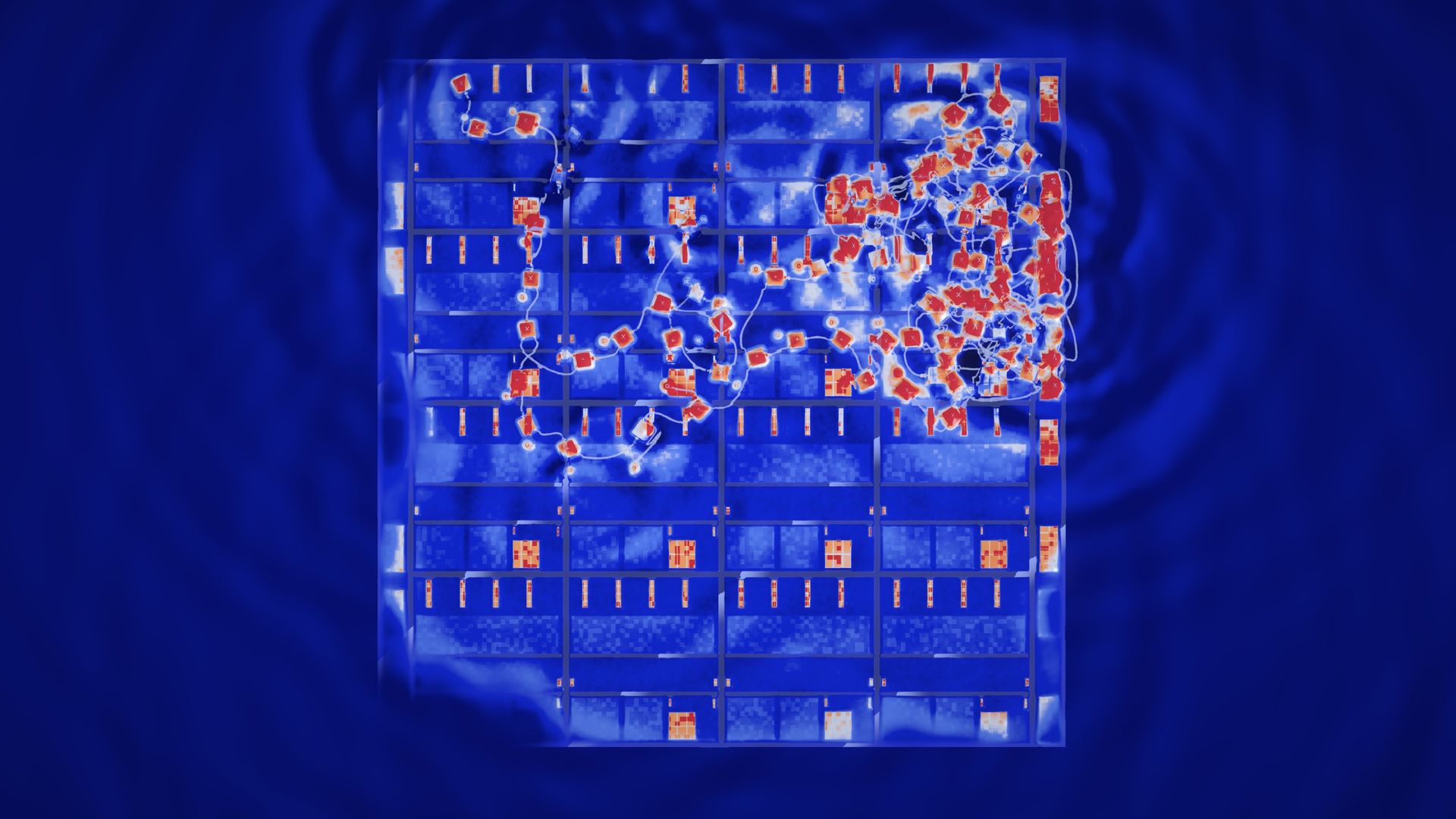
- Core News: Architect Labs has successfully utilized autonomous AI agents to design and simulate Frostbite, a novel CPU architecture based on interaction nets.
- Key Metric/Data: The new architecture achieves 4.59x the performance-per-watt of standard in-order cores, marking a significant leap in energy efficiency for general-purpose computing.
- Strategic Impact: This development signals a paradigm shift where AI transitions from optimizing existing silicon to architecting fundamental hardware logic, potentially disrupting the traditional semiconductor design cycle.
Developing News & Core Details
In a groundbreaking announcement that challenges the decades-old dogma of human-led chip architecture, Architect Labs has unveiled Frostbite, a central processing unit (CPU) designed entirely by autonomous AI agents. Unlike previous iterations where artificial intelligence served merely as an optimization tool for existing designs—such as placing memory blocks or routing power grids—this project represents a generative leap: the AI conceived the fundamental logic of the processor from scratch.
The core innovation lies in Frostbite’s architectural foundation: interaction nets. Traditional CPUs rely on rigid, sequential instruction pipelines (in-order execution) that struggle with complex data dependencies and power constraints. Interaction nets, conversely, utilize a graph-based computational model where operations are defined by their interactions rather than linear steps. This allows for massive parallelism and dynamic resource allocation, mimicking the fluidity of biological neural networks but applied to deterministic computing tasks.
According to Architect Labs’ data, Frostbite delivers 4.59x the performance-per-watt compared to a baseline in-order core. This metric is critical as the industry grapples with “power walls”—the physical limits of how much heat silicon can dissipate without melting or requiring excessive cooling infrastructure. By achieving superior efficiency, Frostbite suggests that future data centers and edge devices could run cooler, faster, and cheaper.
Technical Analysis & Competitive Landscape
To understand the magnitude of this achievement, one must contextualize it within the current semiconductor landscape. For over 50 years, CPU design has been a human-centric endeavor involving thousands of engineers manually refining micro-architectures like Intel’s Core or AMD’s Ryzen. These designs prioritize compatibility with legacy software and predictable performance, often at the cost of raw efficiency.
Frostbite disrupts this by leveraging neuro-symbolic AI. The agents didn’t just tweak parameters; they synthesized a new instruction set architecture (ISA) compatible with interaction nets. This is akin to inventing a new language rather than just writing better books in an existing one. The implications for the competitive landscape are profound:
- Intel & AMD: These giants, currently iterating on their 14nm and 5nm processes, face pressure not just from TSMC’s manufacturing prowess but from a fundamental rethinking of what a CPU core should be. If Frostbite can maintain compatibility with existing software stacks while offering superior efficiency, the cost of entry for new architectures drops significantly.
- Google & NVIDIA: These companies have long experimented with tensor cores and TPU (Tensor Processing Units) for AI workloads. Frostbite demonstrates that interaction nets could be generalized beyond AI training to general-purpose computing, blurring the line between specialized accelerators and traditional CPUs.
- The Design Cycle: Traditionally, a chip takes 2-3 years from concept to silicon. With AI agents handling the heavy lifting of simulation and verification, Architect Labs claims they can iterate designs in weeks or months. This acceleration could lead to “software-defined hardware” where chips are updated remotely via firmware updates that alter their underlying interaction graph.
The technical hurdle remains software compatibility. Interaction nets require a different programming model than x86 or ARM. However, if Architect Labs can provide a compiler layer that translates high-level code (like C++ or Python) into efficient interaction-net instructions without performance penalties, the barrier to adoption will vanish.
Industry & Strategic Implications
The emergence of Frostbite signals the dawn of Autonomous Hardware Engineering. In this new era, AI agents will not only write code but also design the silicon that executes it. This creates a feedback loop where hardware is optimized specifically for the software patterns generated by AI, and vice versa.
For Enterprise IT: The 4.59x efficiency gain translates directly to reduced operational expenditures (OpEx). Data centers currently consume over 1% of global electricity; a shift toward interaction-net architectures could slash this footprint dramatically, aligning with aggressive ESG goals and reducing cooling costs.
For Investors: The semiconductor supply chain is poised for disruption. Companies that master the “AI-to-Silicon” pipeline will become the new gatekeepers of computing power. Architect Labs’ success validates the thesis that AI agents can handle complex, multi-variable engineering problems previously thought to require human intuition.
For Consumers: We may see a future where laptops run for days on a single charge and servers operate silently in small footprints. The “interaction-net” paradigm could enable devices that adapt their processing power dynamically based on task complexity, moving away from the static clock speeds of today.
“Frostbite is not merely an incremental improvement; it is a proof-of-concept for a new era where AI agents design the very fabric of computation. The transition from human-led to agent-led architecture marks the end of the traditional semiconductor cycle and the beginning of self-evolving hardware.”
Final Outlook
The release of Frostbite by Architect Labs is a watershed moment in technology history. It proves that AI agents can conceive, simulate, and validate complex hardware architectures that outperform human-designed counterparts in critical metrics like performance-per-watt.
Looking ahead, the industry will likely see a bifurcation: traditional CPUs (x86/ARM) will continue to dominate legacy applications requiring strict compatibility, while interaction-net-based chips like Frostbite will carve out niches in AI inference, high-performance computing, and energy-constrained edge devices. The next 12-24 months will be pivotal as the industry tests whether these AI-designed cores can scale from simulation to physical silicon fabrication without losing their efficiency edge.
If successful, we are witnessing the birth of Self-Evolving Silicon, where hardware designs continuously adapt and improve through autonomous agent loops, creating a computing ecosystem that is as dynamic and responsive as the AI models running on top of it. The era of static chips designed by humans in boardrooms may be drawing to a close.



