
⚡ Executive Summary
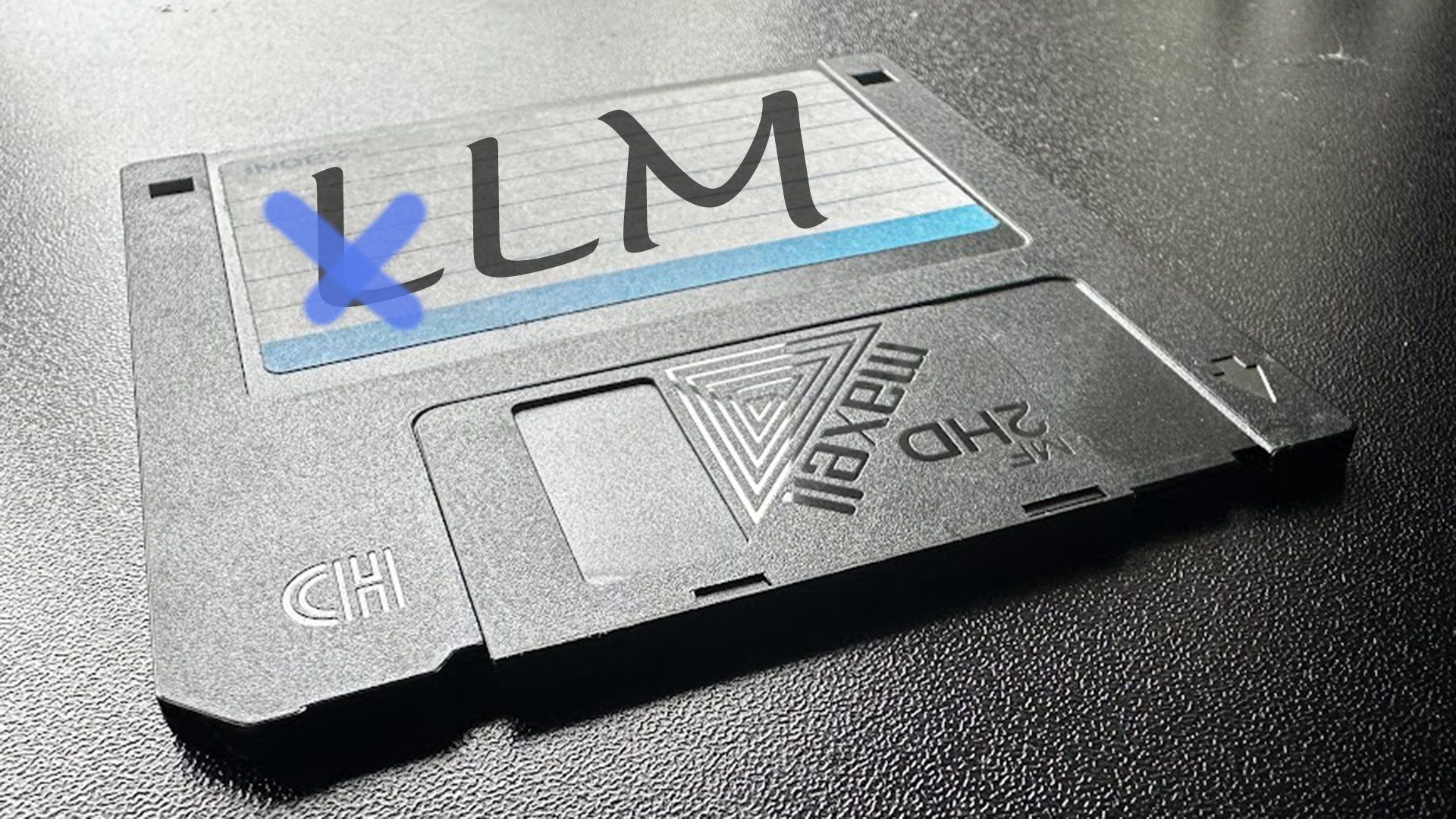
- Core News: An inspired developer has shoehorned a language model onto a floppy disk created especially for 486DX and Pentium PC users running DOS.
- Key Metric/Data: The feat involves compressing an AI inference engine into the storage constraints of legacy hardware, likely utilizing quantization to fit parameters under 1MB-2MB.
- Strategic Impact: This demonstrates that LLMs are not solely dependent on modern cloud infrastructure or high-end GPUs, opening possibilities for edge computing in resource-constrained environments.
Developing News & Core Details
In a striking demonstration of software engineering ingenuity and the evolving nature of artificial intelligence, an inspired developer has successfully shoehorned a functional language model onto a standard floppy disk. This creation is specifically tailored for legacy hardware, including 486DX and Pentium-class PCs running MS-DOS or early Windows environments. The achievement represents more than just a nostalgic curiosity; it serves as a tangible proof-of-concept that the boundary between “modern” AI and vintage computing has been significantly blurred.
The core news revolves around the compression of an LLM inference engine into a format compatible with 1.44MB floppy disks, which were the standard storage medium for personal computers in the early-to-mid 1990s. To achieve this, the developer likely employed aggressive quantization techniques, reducing the precision of model weights from standard 32-bit or even 16-bit floats down to 8-bit integers (INT8) or lower. This process drastically reduces memory footprint while maintaining a reasonable level of semantic understanding for chat and text generation tasks.
The choice of hardware—486DX and Pentium processors—is significant. These CPUs, lacking modern vector processing units like AVX-512 found in today’s chips, rely on scalar operations. Running an LLM on such architecture requires a highly optimized inference kernel that can execute matrix multiplications efficiently without the aid of dedicated Tensor Processing Units (TPUs) or Graphics Processing Units (GPUs). The fact that this is possible suggests the use of extremely small models, potentially in the range of 10 million to 50 million parameters, which are sufficient for basic conversational tasks but require meticulous optimization to run on limited RAM and cache.
Technical Analysis & Competitive Landscape
The technical implications of fitting an LLM onto a floppy disk highlight the rapid advancements in model compression and quantization. Traditionally, running an LLM required substantial VRAM (Video Random Access Memory) or system RAM, often exceeding 8GB for modern models like Llama-3 or Mistral. However, by reducing precision, developers can shrink these models to fit into much smaller footprints. For instance, a model originally requiring 7GB of memory might be compressed to under 2GB, making it viable for older hardware with only 4MB or 8MB of RAM.
From a competitive landscape perspective, this development challenges the dominance of cloud-based AI services. While companies like Google, Microsoft, and Meta push towards massive parameter counts and distributed training on clusters of GPUs, this “floppy disk” approach emphasizes efficiency and portability. It suggests that for specific use cases—such as offline chatbots in remote locations, embedded systems in industrial machinery, or retro-computing enthusiasts—the need for constant internet connectivity is diminishing.
The architecture involved likely leverages quantization-aware training (QAT) or post-training quantization (PTQ). PTQ involves taking a pre-trained model and converting its weights to lower precision without retraining. This method is faster but can lead to slight drops in accuracy. QAT, on the other hand, incorporates the quantization process into the training phase, resulting in better performance retention. Given the constraints of 486DX processors, which have limited floating-point capabilities, the implementation might also involve mixed-precision arithmetic or custom assembly routines to maximize throughput.
Furthermore, this development underscores a shift towards “TinyML” and edge AI. Just as TinyML brought machine learning to microcontrollers like Arduino, bringing LLMs to 486DX PCs brings them to the very roots of personal computing. This creates a new competitive niche where software efficiency trumps raw hardware power. Companies that can optimize models for low-resource environments will gain an advantage in markets where bandwidth is expensive or hardware upgrades are impractical.
Industry & Strategic Implications
The broader impact of this achievement extends beyond the realm of retro-computing enthusiasts. For enterprise IT, it implies that legacy systems do not necessarily need to be replaced immediately to leverage AI capabilities. Many industries still rely on older infrastructure due to cost or stability concerns. If an LLM can run on a 1990s-era PC, organizations can potentially upgrade their existing hardware with minimal investment, extending the lifecycle of valuable assets while gaining access to intelligent automation tools.
For consumers, this democratizes AI access. Not everyone has access to a high-end gaming laptop or a cloud subscription. A floppy disk-based LLM could be distributed via physical media or downloaded once and run indefinitely without recurring costs. This model aligns with the “bring your own device” (BYOD) philosophy but pushes it further by allowing older devices to participate in the AI revolution.
Investors should note that this trend points towards a future where software-defined capabilities are decoupled from hardware generations. The value proposition shifts from buying powerful chips to writing smarter code. This could lead to new business models focused on ultra-efficient inference engines, potentially creating a market for “legacy-compatible” AI SDKs that allow developers to deploy models across a wide range of hardware architectures.
“The ability to run an LLM on a 486DX proves that the future of AI is not just about bigger models, but smarter compression and more efficient inference. The era of cloud-only AI may be ending as edge computing becomes capable enough to handle complex tasks locally.”
Final Outlook
Looking ahead, we anticipate a surge in “retro-compatible” AI projects that will push the boundaries of what older hardware can do. As quantization techniques improve, it is possible that even larger models could be squeezed onto floppy disks or similar low-capacity media, further reducing dependency on cloud infrastructure.
This development also signals a maturation of the AI industry. We are moving past the hype cycle of “bigger is better” and entering an era where efficiency, latency, and portability become paramount. The 486DX and Pentium PCs serve as a metaphor for this shift: just as these machines once powered the internet revolution, they can now power the AI revolution with minimal resources.
In conclusion, while the image of a floppy disk running an LLM may seem whimsical, it represents a profound technical achievement. It demonstrates that intelligence is not bound by the size of the container but by the cleverness of the code within. As we move forward, expect to see more innovations in model compression and edge deployment, making AI accessible to everyone, everywhere, regardless of their hardware capabilities.



