
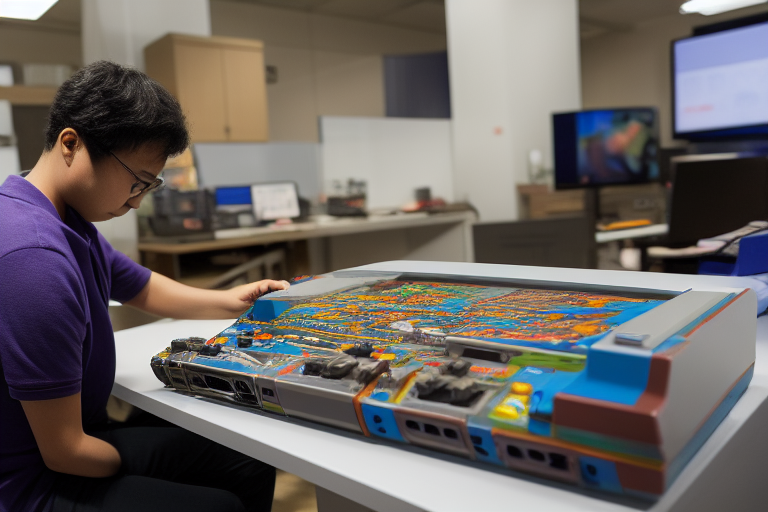
⚡ Executive Summary
- Core News: A hardware hacker has successfully deployed a custom ChatGPT client on a 35-year-old Super Nintendo Entertainment System (SNES), leveraging the console’s iconic Super FX 2 coprocessor to accelerate token processing.
- Key Metric/Data: The vintage setup processes responses for a scaled-down 2.2 million parameter Large Language Model running at a clock speed of 21 MHz.
- Strategic Impact: This engineering feat highlights the enduring utility of retro architectures, demonstrating how edge-computing paradigms and hardware acceleration can squeeze modern AI workloads onto hardware designed over three decades ago.
Developing News & Core Details
The intersection of vintage consumer electronics and bleeding-edge artificial intelligence has yielded one of the most eccentric hardware hacks in recent memory. A specialized enthusiast has ported a functional ChatGPT client to run natively on the Super Nintendo Entertainment System (SNES), a 16-bit home video game console originally launched by Nintendo in 1990. Far from a simple text-rendering gimmick, the project achieves hardware acceleration by routing computational tasks through the legendary Super FX 2 chip—a dedicated RISC coprocessor famous for powering early 3D polygon classics like Super Mario World 2: Yoshi’s Island and Star Fox.
To make conversational AI viable on hardware that predates modern deep learning by decades, the project relies on a heavily quantized, miniature language model. Scaled down to just 2.2 million parameters, the model is small enough to fit within memory constraints while still generating coherent, context-aware conversational replies. The SNESRicoh 5A22 main CPU (running at a modest 3.58 MHz) handles system coordination, while the Super FX 2 chip—clocked at a blistering 21 MHz—takes on the heavy mathematical lifting required to compute inference steps. The resulting system bridges a 35-year technological chasm, proving that parallel computing principles forged in the era of 16-bit gaming cartridges retain conceptual relevance in the era of transformer-based generative AI.
Technical Analysis & Competitive Landscape
From an architectural standpoint, running a neural network on an SNES cartridge is an exercise in extreme constraint management. A modern server-grade GPU like an NVIDIA H100 boasts thousands of tensor cores and operates at teraflops scale, whereas the Super FX 2 (formally designated as the GSU-2 or MARIO chip) is a custom 16-bit RISC processor designed primarily for geometry calculations, vector rotation, and rasterization. With a 21 MHz clock rate and severely limited onboard RAM, the chip must perform matrix multiplications and activation functions under conditions that would cause modern machine learning engineers to despair.
This achievement upends traditional notions of hardware obsolescence. While the enterprise tech sector fixates on exponential scaling, trillion-parameter foundational models, and liquid-cooled data centers, projects like the SNES ChatGPT client champion the counter-movement of ultra-constrained edge computing. By optimizing model weights, leveraging INT4/INT8 quantization, and offloading compute-heavy tensor operations to dedicated vintage coprocessors, developers underscore that intelligence density can be dramatically compressed. While this system cannot compete with cloud-hosted LLMs in terms of latency or nuance, it serves as a masterclass in resourceful systems engineering, demonstrating that inference is ultimately bound by algorithmic cleverness as much as raw silicon muscle.
Industry & Strategic Implications
Beyond its viral novelty and nostalgic appeal, this hardware hack carries broader implications for the Internet of Things (IoT), embedded systems, and microcontroller-based AI development. As industries push to embed ambient intelligence into low-power, legacy, or resource-constrained devices—ranging from industrial sensors to smart home appliances—the methodologies used to squeeze a 2.2M parameter model onto a 1990s gaming console become directly applicable. Developers working on microcontrollers (such as ESP32 or ARM Cortex-M chips) face similar memory footprints and clock-speed bottlenecks.
Furthermore, the project democratizes the conceptual understanding of how neural networks execute at the metal level. By stripping away layers of software abstraction—such as Python, PyTorch, and CUDA—and forcing the model to interact directly with assembly-level hardware instructions and cartridge memory maps, engineers gain a visceral appreciation for memory bandwidth optimization and instruction set architecture (ISA) efficiency. In an era where software bloat is an escalating enterprise concern, the discipline required to run modern AI on retro hardware offers a refreshing masterclass in lean code execution.
“Squeezing modern generative intelligence into a 35-year-old cartridge isn’t just about bending retro hardware to our will—it’s a stark reminder that efficiency, quantization, and architectural cleverness can bridge eras that seem technologically worlds apart.”
Final Outlook
The successful deployment of a ChatGPT client on a Super FX 2-accelerated SNES is a testament to human ingenuity and the boundless creativity of the hardware hacking community. While we are unlikely to see retro game consoles replacing cloud datacenters or edge AI accelerators in commercial deployment, the underlying principles of this experiment will ripple outward. As edge AI continues its rapid maturation, the techniques pioneered by hobbyists to run complex neural workloads on minimal silicon will help inform the next generation of hyper-efficient, low-power smart devices.
Ultimately, this milestone bridges the past and the future of computing in a profound way. It honors the visionary hardware designers of the 1990s—whose RISC coprocessors were decades ahead of their time—while pointing toward a future where artificial intelligence is ubiquitous enough to run on literally anything with a clock and a transistor.
⚡ Featured Enterprise & AI Infrastructure Picks
Building high-throughput AI pipelines or upgrading your workstation? Explore our curated cloud hosting, GPU workstations, and enterprise software stack.



