
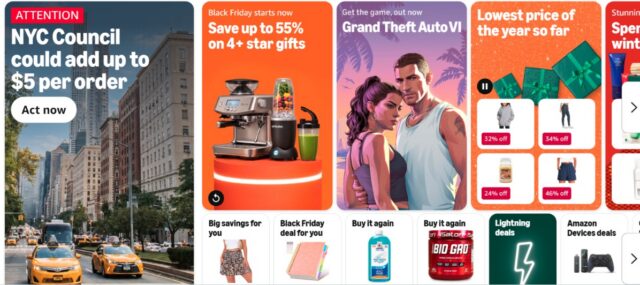
⚡ Executive Summary
- Core News: Amazon has officially activated its shopping interface as a political megaphone, deploying full-page homepage banners and persistent in-app pop-ups to rally consumer opposition against the proposed Delivery Protection Act (DPA).
- Key Metric/Data: The DPA mandates that third-party delivery services (like Uber Eats or DoorDash) must offer a 10% discount on Amazon Prime subscriptions, effectively forcing Amazon to subsidize competitors’ logistics costs.
- Strategic Impact: This marks a shift from traditional lobbying to “digital direct-to-consumer” advocacy, leveraging Amazon’s massive user base (300M+ monthly active users) to create immediate market pressure and brand loyalty shifts against regulatory mandates.
Developing News & Core Details
The recent deployment of aggressive digital signage by Amazon represents a significant escalation in the corporate response to the Delivery Protection Act. The legislation, championed by various state and federal bodies, aims to level the playing field between incumbent e-commerce giants and emerging gig-economy delivery platforms. Under the DPA’s framework, if a third-party logistics provider (3PL) delivers an item purchased on Amazon, that 3PL is entitled to a 10% discount on the customer’s Prime membership fee.
Amazon’s response has been swift and visually dominant. By integrating full-width banners into its homepage and intrusive pop-ups within the mobile application, Amazon is not merely informing users; it is actively curating a narrative of consumer victimization. The messaging frames the DPA as an “unfair tax” on Prime members, suggesting that the legislation forces customers to pay for services they did not explicitly choose (the 3PL delivery) while simultaneously subsidizing competitors.
Technically, this campaign leverages Amazon’s sophisticated A/B testing infrastructure. The pop-ups are likely dynamically served based on user behavior—targeting Prime members with specific discount calculators or highlighting the “hidden cost” of third-party deliveries. This creates a feedback loop where high-traffic users (Prime subscribers) see the most compelling arguments, maximizing conversion rates for political alignment.
Technical Analysis & Competitive Landscape
From an architectural and market dynamics perspective, Amazon’s move highlights the convergence of retail infrastructure and digital public relations. Historically, tech giants like Amazon relied on heavy lobbying expenditures in Washington D.C. to shape legislation (e.g., the 1998 Online Shopping Act). However, the modern regulatory landscape has shifted power toward the consumer base. The DPA represents a direct challenge to Amazon’s “last-mile” monopoly, which currently allows it to bundle delivery services with its subscription model at near-zero marginal cost.
The core technical friction lies in the definition of “delivery.” If a customer buys a laptop from Best Buy and has it shipped via Amazon Logistics (FBA), does that count as an Amazon sale or a 3PL service? The DPA blurs these lines. Amazon’s digital campaign effectively argues for a strict interpretation: if the transaction originates on Amazon.com, the Prime fee belongs to Amazon, regardless of who physically moves the box.
Competitively, this puts pressure on rivals like DoorDash and Uber Eats. These companies operate on razor-thin margins; a 10% discount mandate could erode their profitability or force them to raise prices elsewhere. By framing the issue as “Amazon vs. The People,” Amazon positions itself not just as a retailer but as the defender of consumer value against bureaucratic overreach. This mirrors historical tech battles, such as Microsoft’s anti-trust defense in the 90s, where technical complexity was used to justify market dominance.
Furthermore, this campaign tests the limits of “platform neutrality.” Amazon is using its own walled garden (the shopping app) to influence external policy debates. This creates a precedent where future legislation might require platforms to remain politically neutral or risk being labeled as “partisan” entities, potentially triggering new regulatory scrutiny into their data usage and ad targeting capabilities.
Industry & Strategic Implications
The broader implication for enterprise IT and the SaaS sector is profound. If Amazon successfully defines the DPA narrative through its user interface, other platforms (e.g., Apple App Store, Google Play) may follow suit, turning their ecosystems into political battlegrounds. This could lead to a new category of “Digital Lobbying,” where software interfaces are optimized not just for conversion, but for legislative alignment.
For investors, this signals a shift in risk assessment. Regulatory risk is no longer just about tax rates or antitrust fines; it includes the cost of defending one’s brand identity against direct consumer mobilization. Amazon’s ability to instantly deploy millions of dollars worth of digital real estate (banners/pop-ups) demonstrates that their “moat” extends beyond logistics into cognitive influence.
Consumers, meanwhile, face a new layer of decision fatigue. The DPA forces them to choose between convenience (Prime bundling) and perceived fairness (discounts for 3PLs). Amazon’s campaign aims to make the latter feel like an unnecessary burden, potentially driving users toward competitors who offer “cleaner” delivery models or lower subscription fees.
“The Delivery Protection Act battle is no longer just about shipping boxes; it is a test of whether tech giants can successfully weaponize their user interfaces to redefine legislative outcomes in real-time.”
Final Outlook
If Amazon’s digital blitz succeeds, we may see the DPA diluted or modified before final passage. The company has demonstrated that its most powerful asset is not its warehouse network, but its ability to instantly align 300 million users with a specific political narrative. Future regulatory frameworks will likely need to account for “platform influence,” potentially requiring transparency reports on how much digital real estate tech giants dedicate to lobbying efforts.
In the short term, expect Amazon to continue rotating messaging themes—shifting from “consumer protection” to “logistical efficiency” as needed. Long-term, this sets a precedent where the line between commerce and politics blurs within the software stack itself. The next major tech regulation may not be debated in committee rooms alone, but visualized directly on your shopping cart page.



