
⚡ Executive Summary
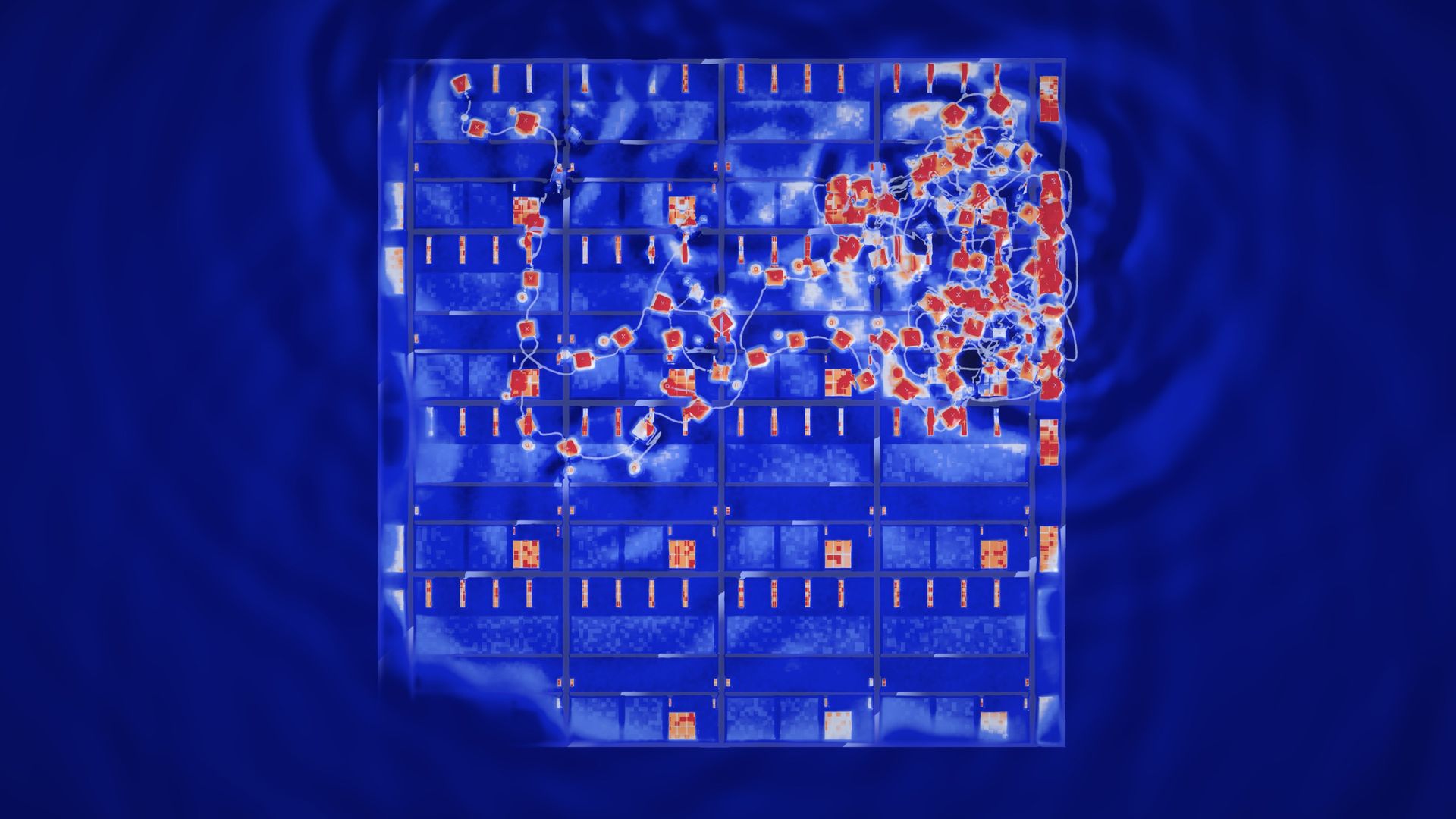
- Core News: Architect Labs has successfully utilized its proprietary AI agents to design and simulate Frostbite, a novel CPU architecture based on interaction nets.
- Key Metric/Data: The new architecture delivers 4.59x the performance per watt compared to standard in-order cores, marking a significant leap in energy efficiency.
- Strategic Impact: This development signals a paradigm shift from human-centric design to autonomous engineering, potentially disrupting the semiconductor industry’s reliance on traditional R&D cycles.
Developing News & Core Details
In a groundbreaking announcement that challenges the decades-old dogma of semiconductor development, Architect Labs has unveiled Frostbite, a central processing unit (CPU) architecture entirely conceived and optimized by its suite of AI agents. Unlike conventional designs where human architects manually define pipeline stages, cache hierarchies, and instruction set architectures (ISA), Frostbite emerged from an autonomous design loop driven by interaction-net principles.
The core innovation lies in the transition from rigid, sequential processing to a more fluid, parallelized approach known as “interaction nets.” Traditional CPUs operate on the von Neumann architecture, where data and instructions are stored separately, often creating bottlenecks. Frostbite, however, utilizes an interaction-net model that allows for dynamic, concurrent computation, theoretically enabling higher throughput without the exponential increase in power consumption typically associated with such complexity.
Architect Labs reports that Frostbite achieves 4.59x the performance per watt of a standard in-order core. This metric is critical as the industry grapples with “power walls”—the physical limits where increasing clock speeds leads to thermal runaway rather than computational gains. By optimizing for efficiency at the architectural level, Frostbite suggests that future computing power may come not from faster transistors, but from smarter topologies.
Technical Analysis & Competitive Landscape
To understand the magnitude of this achievement, one must look at the historical context of CPU design. For over 50 years, companies like Intel and AMD have relied on human engineers to iterate through millions of transistor configurations. This process is slow, expensive, and often constrained by human intuition rather than exhaustive simulation.
The Interaction-Net Paradigm
Frostbite’s architecture represents a move toward “spatial computing” within the CPU itself. In an interaction-net system, data flows through a network of interacting nodes rather than linear registers. This mimics biological neural networks or cellular automata, allowing for massive parallelism. The AI agents at Architect Labs didn’t just tweak existing designs; they synthesized a new topology that balances latency and throughput in ways humans might not intuitively prioritize.
Competitive Implications
In the current landscape, where NVIDIA dominates with GPU-based parallelism and ARM competes on mobile efficiency, Frostbite introduces a third vector: architectural autonomy. If AI agents can design CPUs that outperform human-designed ones in power efficiency, the competitive moat for legacy semiconductor giants could erode. Startups like Architect Labs no longer need to compete solely on manufacturing yield; they can compete on raw architectural novelty.
The rivalry is also shifting from “who has the fastest chip” to “who has the smartest design partner.” As AI agents become capable of simulating teraflops of compute in days rather than years, the R&D cycle for CPUs could compress by an order of magnitude. This puts pressure on established players to either integrate their own AI design teams or risk obsolescence.
Industry & Strategic Implications
The implications of Frostbite extend far beyond a single startup’s product launch. For Enterprise IT, the 4.59x efficiency gain translates directly into reduced data center cooling costs and lower electricity bills, which are currently among the largest operational expenses for hyperscalers.
Consumer Electronics & Edge Computing
For consumer devices, this architecture could enable high-performance computing in battery-constrained environments. Imagine laptops that run AI models locally without draining the battery, or IoT sensors capable of real-time image processing with minimal power draw. Frostbite’s efficiency makes it a prime candidate for the next generation of edge AI.
Investor Perspective
From an investment standpoint, Architect Labs is positioning itself at the intersection of two megatrends: Generative AI and Semiconductor Innovation. Investors are increasingly looking for companies that leverage AI not just to run applications, but to build the hardware infrastructure. Frostbite validates the thesis that “AI designing chips” is no longer a theoretical concept but a tangible reality with measurable performance gains.
“The transition from human-designed architectures to AI-autonomous design represents a fundamental shift in how we define computational limits. If Frostbite’s 4.59x efficiency holds up in real-world silicon, it could redefine the cost-benefit ratio of data center operations globally.”
Final Outlook
The emergence of Frostbite signals that the era of incremental CPU improvements is ending, replaced by an era of architectural reinvention driven by artificial intelligence. While challenges remain—such as translating simulation results into physical silicon and ensuring software compatibility—the trajectory is clear.
In the near future, we may see a hybrid model where human architects define high-level goals (e.g., “maximize throughput for neural networks”), while AI agents handle the granular optimization of transistor placement and interaction logic. Frostbite is not just a new CPU; it is a proof-of-concept that the design process itself has been automated, accelerated, and optimized.
As the semiconductor industry faces diminishing returns from Moore’s Law, solutions like Frostbite offer a path forward: smarter architectures designed by even smarter machines. For Architect Labs, this is just the beginning of a new chapter in hardware evolution, one where the line between software intelligence and physical reality blurs.



