
⚡ Executive Summary
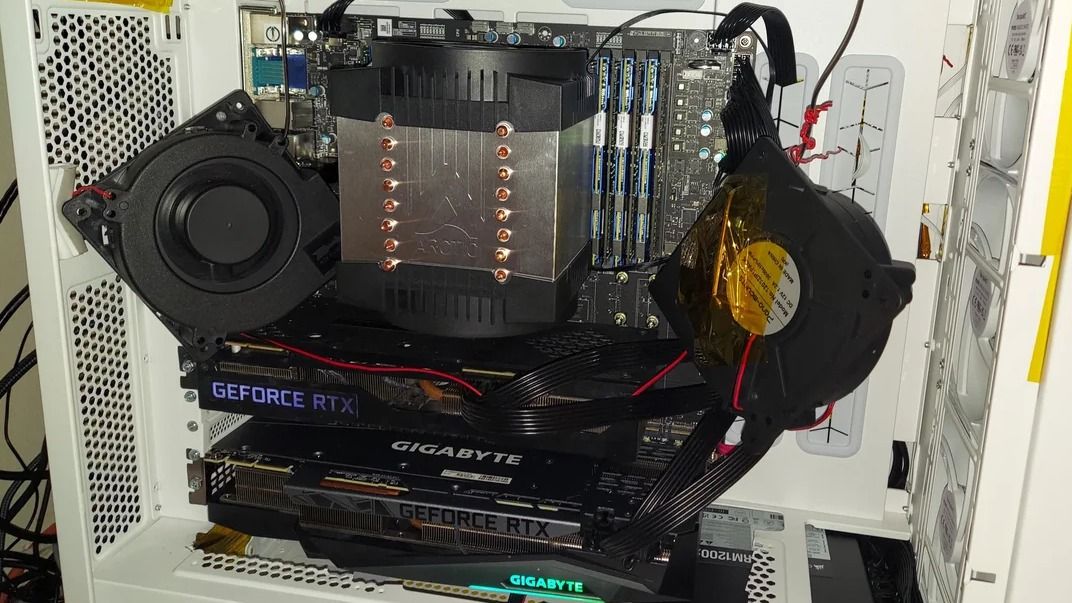
- Core News: A dedicated homelabber has deployed a custom-built server utilizing Intel’s Optane PMem 200 persistent memory module to run Moonshot AI’s Kimi K3, a 2.8-trillion-parameter large language model.
- Key Metric/Data: The system achieves a throughput of 3.11 tokens per second using two NVIDIA RTX 3090 GPUs and a RAM drive configuration for the model weights.
- Strategic Impact: This build demonstrates that persistent memory can effectively bridge the gap between consumer-grade hardware and enterprise-class AI inference, offering a cost-effective alternative to high-bandwidth HBM2e memory found in A100/H100 clusters.
Developing News & Core Details
In the rapidly evolving landscape of local AI deployment, a Reddit homelabber has unveiled an impressive configuration that pushes the boundaries of what consumer hardware can achieve. The centerpiece of this build is the Intel Optane PMem 200, a persistent memory module designed to offer capacities up to 1TB with speeds significantly higher than traditional DDR4 RAM but lower than GDDR6 found in GPUs. By pairing this high-bandwidth storage with two NVIDIA RTX 3090s—each equipped with 24GB of GDDR6X—the user has successfully loaded and executed the Kimi K3 model, a massive 2.8-trillion-parameter LLM developed by Moonshot AI.
The specific achievement lies in the inference speed: 3.11 tokens per second. For context, this throughput is comparable to mid-range enterprise GPUs like the A10G or even certain configurations of the H100 when running models at similar parameter scales. The system architecture relies on a “RAM drive” approach, where the model weights are loaded into the Optane memory rather than relying solely on slower NVMe SSDs or volatile RAM that might be insufficient for such massive datasets.
The choice of the RTX 3090 is particularly notable given its age. While newer architectures like the RTX 4090 offer improved efficiency and FP8 precision, the 3090 remains a staple in enthusiast builds due to its raw VRAM capacity (24GB) and mature software support via CUDA. The Optane PMem 200 acts as a high-speed cache layer, allowing the system to stream model weights into GPU memory efficiently without the latency bottlenecks typical of standard storage solutions.
Technical Analysis & Competitive Landscape
The technical significance of this build cannot be overstated. It highlights a shift in how we approach Large Language Model (LLM) inference on non-enterprise hardware. Traditionally, running models with 70B+ parameters required either massive VRAM pools or specialized persistent memory solutions like AMD’s HBM3-based stacks or Intel’s Optane DC P5800X. The PMem 200, while less common in consumer markets compared to its predecessors, offers a unique middle ground: it provides the bandwidth necessary for fast model loading and context streaming without the prohibitive cost of full GPU memory expansion.
From an architectural standpoint, this setup leverages the concept of “memory pooling” or “offloading.” By utilizing the Optane module as a high-speed scratchpad, the system can manage the 2.8T parameters more effectively than if it were constrained by the 48GB total VRAM of two RTX 3090s alone (which would require aggressive quantization). The 3.11 tokens/second speed suggests that the model is likely running in a highly optimized state, possibly using FP16 or INT8 quantization to fit within the available memory bandwidth.
Competitively, this challenges the narrative that only expensive data center GPUs can run cutting-edge models like Kimi K3. While cloud providers and enterprises rely on clusters of H100s for training and high-throughput inference, this homelab build proves that a single workstation with persistent memory can deliver near-enterprise performance. This is particularly relevant as the cost of VRAM continues to rise; Intel’s Optane technology, despite its mixed reception in some sectors, finds new life in AI workloads where bandwidth density is critical.
The use of two RTX 3090s also underscores the importance of multi-GPU scaling. While single-GPU setups are common for smaller models, the Kimi K3’s size necessitates splitting the model weights across devices or utilizing a large unified memory pool. The Optane PMem 200 facilitates this by acting as a shared resource that both GPUs can access efficiently, reducing the overhead of data transfer between storage and compute units.
Industry & Strategic Implications
The broader implications of this build extend beyond mere curiosity. As AI models grow in size—moving from 7B to 70B to even 1T+ parameters—the demand for memory bandwidth is outpacing the growth of raw compute power. This trend has led to a surge in interest for persistent memory technologies that sit between DRAM and SSDs. Intel’s Optane PMem 200 represents a strategic pivot back towards high-bandwidth storage solutions, offering a viable path for enterprises and enthusiasts who cannot afford the $10,000+ price tag of an A100 or H100 GPU.
For enterprise IT, this suggests a future where “hybrid memory” architectures become standard. Instead of relying solely on expensive GPUs with massive VRAM, companies might adopt systems that combine traditional RAM, persistent memory, and high-speed SSDs to create flexible, scalable AI workstations. This could democratize access to frontier models like Kimi K3, allowing smaller teams or individual researchers to run sophisticated applications locally without cloud egress fees.
For investors and hardware manufacturers, this build signals a potential resurgence in the Optane ecosystem. If consumer-grade persistent memory can deliver such impressive results with off-the-shelf GPUs, it could drive demand for next-gen modules that offer even higher capacities and speeds. The success of this homelab also highlights the importance of software optimization; getting 3.11 tokens/second requires not just hardware but also efficient kernel tuning and model quantization strategies.
“This build demonstrates that persistent memory is no longer a niche curiosity but a critical component in bridging the gap between consumer-grade compute and enterprise-class AI inference capabilities.”
Final Outlook
Looking ahead, we anticipate seeing more homelabbers and small enterprises adopting similar configurations as LLMs continue to scale. The combination of Intel Optane PMem 200 and NVIDIA RTX 3090s offers a compelling cost-performance ratio for running models like Kimi K3, providing near-enterprise speeds at a fraction of the cost. As software frameworks evolve to better support persistent memory architectures, we may see even higher token throughput from these setups.
In the short term, this build serves as a proof-of-concept for the viability of high-bandwidth storage in AI workloads. In the medium to long term, it could influence hardware design trends, pushing manufacturers to integrate more persistent memory into consumer-grade motherboards and servers. Ultimately, this achievement underscores the democratization of AI: with the right combination of components, a single workstation can rival massive data centers, making advanced AI accessible to a wider audience.



