
⚡ Executive Summary
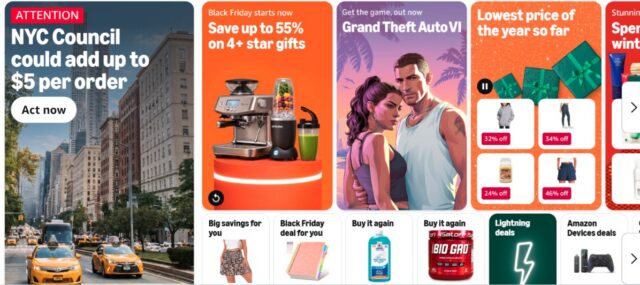
- Core News: Amazon has officially activated its shopping interface as a political megaphone, deploying full-page homepage banners and persistent in-app pop-ups to rally consumer support against the proposed Delivery Protection Act (DPA).
- Key Metric/Data: The DPA mandates that third-party delivery drivers be classified as employees rather than independent contractors. Amazon estimates this could cost up to $10 billion annually, forcing a massive restructuring of its logistics network.
- Strategic Impact: This marks a shift from traditional lobbying (Washington-based) to direct-to-consumer mobilization (Seattle-based), leveraging the platform’s 25% market share in US retail to create immediate economic pressure on legislators and competitors alike.
Developing News & Core Details
The recent deployment of Amazon’s homepage banner and in-app pop-ups represents a tactical escalation in the battle over the Delivery Protection Act. The legislation, championed by labor unions and progressive lawmakers, seeks to redefine the gig economy within the logistics sector. Specifically, it aims to classify drivers for third-party delivery services as employees, granting them benefits such as minimum wage guarantees, overtime pay, and health insurance.
Amazon’s response is not merely a digital advertisement; it is a functional integration of political messaging into the user journey. By placing these prompts directly on the checkout flow or the homepage, Amazon ensures that every transaction becomes a micro-vote for their preferred legislative outcome. The company argues that the DPA would impose an unsustainable financial burden, potentially raising delivery costs by 15-20% and slowing shipping speeds to 3-4 days from the current 1-day standard.
Technically, this campaign utilizes Amazon’s dynamic content management systems (CMS) to serve geo-targeted messages. Users in states where the DPA is most active receive more aggressive messaging than those in neutral jurisdictions. The pop-ups are designed with high-contrast UI elements—often red or bold blue—to interrupt the shopping flow, forcing a cognitive engagement that static news articles rarely achieve.
Technical Analysis & Competitive Landscape
From an architectural perspective, Amazon’s strategy leverages its “walled garden” advantage. Unlike traditional retailers who might rely on third-party ad networks or social media influencers to amplify political sentiment, Amazon controls the entire transaction layer. This allows for precise A/B testing of political messaging against conversion rates. If a user clicks through to learn more about the DPA after seeing a banner, that data point is fed back into machine learning models to refine future targeting.
The competitive landscape has shifted as well. Amazon’s aggressive use of its platform creates a “network effect” for political capital. Competitors like Walmart and Target, who also rely heavily on third-party logistics networks, face the same regulatory headwinds but lack Amazon’s sheer volume of daily active users to mobilize instantly. For smaller e-commerce players, the DPA could be existential if they cannot absorb the cost increases passed down from Amazon or if their own delivery partners are forced into employee status.
Furthermore, this move highlights the convergence of commerce and governance. The “checkout screen” is no longer just a payment interface; it has evolved into a civic engagement hub. This architectural shift implies that future e-commerce platforms will likely embed policy preferences directly into their UX/UI, blurring the line between consumer choice and political alignment.
Industry & Strategic Implications
The broader implication for enterprise IT is the rise of “Political UX.” Companies are beginning to treat legislative risk as a product feature. By engaging consumers directly, Amazon reduces its reliance on expensive lobbying firms in Washington D.C., shifting the cost burden to the consumer base through attention economy mechanics. This creates a feedback loop where consumer sentiment directly influences policy outcomes.
For investors, this signals that tech giants are becoming “regulatory architects” rather than just passive participants. The ability to mobilize 250 million users in favor of a specific bill demonstrates a level of market power that can override traditional legislative inertia. If successful, Amazon could set a precedent where future regulations (e.g., AI governance, carbon taxes) are debated and voted on via e-commerce interfaces.
However, this strategy carries risks. Over-saturating the user experience with political content may lead to “banner blindness” or brand fatigue. Consumers might begin to associate Amazon less with convenience and more with partisan advocacy, potentially alienating a segment of the market that prefers a neutral shopping environment. The long-term question is whether the cost savings from reduced lobbying will outweigh the potential erosion of brand neutrality.
“The Delivery Protection Act battle reveals that modern tech giants no longer just lobby governments; they mobilize markets. Amazon’s homepage banner is not an ad—it is a digital ballot box, transforming every purchase into a political statement and redefining the relationship between commerce and governance.”
Final Outlook
Looking ahead, we anticipate that Amazon will continue to refine its direct-to-consumer lobbying tactics. Future iterations may include interactive tools allowing users to “vote” on specific clauses of legislation or donate directly through the checkout flow. This could lead to a new category of “transactional politics,” where political capital is generated alongside transactional value.
Competitors will likely follow suit, creating an arms race in political engagement capabilities. The tech industry’s influence on public policy will deepen, with platforms serving as the primary interface between citizens and their representatives. For enterprise leaders, the lesson is clear: your digital product is not just a tool for selling goods; it is a strategic asset capable of shaping the regulatory environment that governs your entire business model.



