
⚡ Executive Summary
- Core News: The SoHo Playhouse has launched “Love Me,” a one-man show by Drew Michael and Prashanth Venkataramanujam, utilizing Auracast broadcasts to deliver immersive spatial audio directly to the audience via wired headphones.
- Key Metric/Data: The production employs 178-seat capacity with individualized Auracast receivers distributed at entry, ensuring a 100% personalization rate for sound delivery without relying on traditional PA systems or Bluetooth pairing chaos.
- Strategic Impact: This marks a significant shift in live entertainment technology, positioning spatial audio and broadcast standards like Auracast as critical tools for both accessibility compliance (hearing impairment) and high-fidelity artistic expression.
Developing News & Core Details
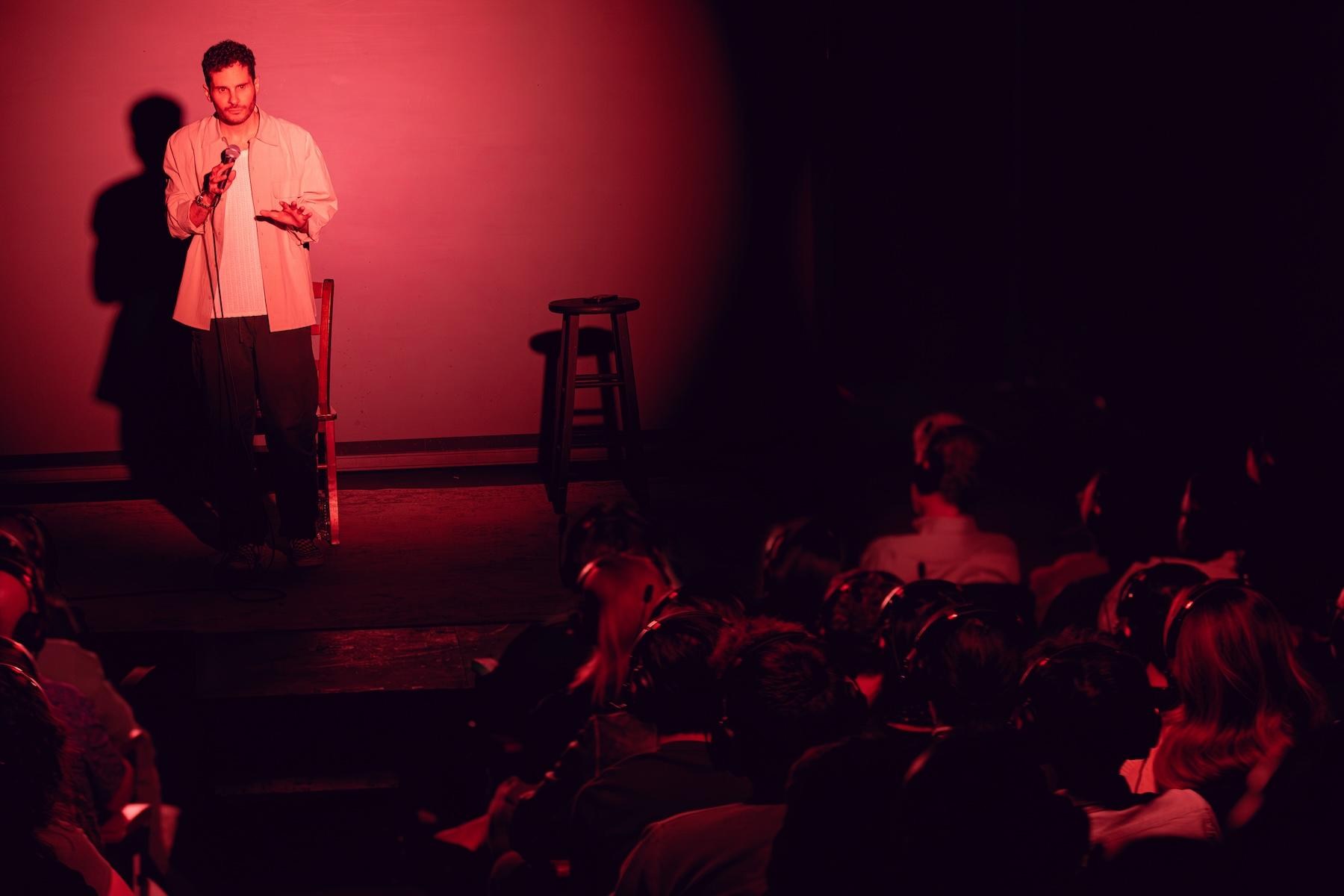
The narrative of “Love Me” begins not with a curtain rise, but with the tactile experience of receiving a black drawstring bag containing wired headphones connected to an Auracast receiver. This physical handoff at the 178-seat SoHo Playhouse in New York City sets a precedent for how digital audio is being consumed in physical spaces. The production, helmed by stand-up comedian Drew Michael and director Prashanth Venkataramanujam, utilizes this technology not merely as an accessory but as an integral storytelling device.
The show explores the complexities of love and connection across five chapters, using sound design to guide the audience’s emotional journey. By integrating Auracast broadcasts, the creators ensure that every listener receives a synchronized, high-fidelity audio track tailored specifically for their seat. This eliminates the latency and interference issues often associated with consumer Bluetooth devices in crowded environments, creating a seamless bridge between the digital broadcast layer and the physical theater experience.
Historically, live theater has relied on either ambient sound (which can be muddy) or bulky assistive listening systems that require manual pairing. “Love Me” disrupts this by leveraging the latest Bluetooth LE Audio standards to create a unified audio environment where accessibility features are indistinguishable from premium sound design elements.
Technical Analysis & Competitive Landscape
The deployment of Auracast in a 178-seat venue represents a sophisticated application of Low Energy (LE) Audio technology. Unlike traditional Bluetooth, which struggles with multipoint connections and interference in dense environments, Auracast is designed for broadcast scenarios where multiple receivers connect to a single source simultaneously.
From an architectural standpoint, the system likely utilizes a central audio server or a dedicated transmitter capable of handling 178 concurrent streams. This requires robust network infrastructure within the theater’s backend, ensuring that the digital signal remains stable and synchronized with the visual performance. The use of wired headphones connected to Auracast receivers further enhances this stability, removing the variable of battery life or wireless dropout from the user experience.
Competitively, this move places “Love Me” at the forefront of a new wave of “smart theater.” Traditional venues are often slow to adopt digital audio due to legacy infrastructure and cost concerns. However, the success of such productions demonstrates that Auracast can be scaled effectively in mid-sized venues (100-200 seats), offering a cost-effective alternative to full-scale surround sound systems while providing superior clarity.
Furthermore, this technology creates a barrier to entry for competitors who have not yet integrated LE Audio standards. Venues that rely on older assistive listening technologies or generic Bluetooth streaming may find themselves unable to match the immersion and accessibility of Auracast-enabled shows. The standardization provided by Auracast also allows for interoperability; future productions could potentially use different hardware brands as long as they adhere to the broadcast profile, fostering a more open ecosystem in live entertainment.
Industry & Strategic Implications
The integration of Auracast into “Love Me” signals a broader trend where accessibility and premium user experience converge. For years, assistive listening devices were often stigmatized as utilitarian tools for the hearing impaired. By embedding them into the core sound design, creators like Michael and Venkataramanujam have normalized their use, making them a standard expectation rather than an afterthought.
For enterprise IT and venue management, this implies a shift towards “always-on” audio architectures. The ability to broadcast high-quality audio to hundreds of individual devices simultaneously suggests that future live events—whether concerts, conferences, or theater performances—will increasingly rely on digital distribution layers rather than analog amplification.
For investors in the consumer electronics and AV sectors, this validates the market potential for Auracast-compatible hardware. As more content creators demand spatial audio capabilities, manufacturers will likely prioritize LE Audio certification to ensure their products can handle broadcast scenarios. This could accelerate the transition from mono/stereo Bluetooth to multi-channel immersive audio in consumer devices.
“The true innovation of ‘Love Me’ lies not just in the hardware, but in the reimagining of sound as a narrative layer—where accessibility and artistic immersion are no longer competing priorities but complementary forces.”
Final Outlook
As we look toward the future of live entertainment, “Love Me” serves as a proof-of-concept for what is possible when legacy venues embrace modern broadcast standards. The success of Auracast in this context suggests that the next generation of theaters will be designed with digital audio infrastructure as a foundational element, much like lighting or acoustics.
We anticipate seeing more productions adopting similar setups, potentially expanding to larger arenas and outdoor events where traditional sound reinforcement is challenging. The convergence of 5G connectivity, spatial audio processing, and Auracast broadcasting will likely create a new category of “hybrid” live experiences that blend physical presence with digital precision.
In conclusion, the show’s tagline—”The show is starting soon. Please turn on your headphones”—has evolved from a simple instruction into a ritual of engagement. It invites the audience to step out of the passive role of observers and into an active, personalized sonic environment, marking a definitive turning point in how we experience live performance.



