
⚡ Executive Summary
- Core News: The 2026 HarmonyOS Collegiate Innovation Competition held its national grand finals at Nanjing University, marking its official inclusion in the national ranking of regular university discipline competitions.
- Key Metric/Data: Huawei executive He Gang confirmed massive momentum as the talent pipeline scales rapidly to meet the deployment demands of a completely independent OS ecosystem.
- Strategic Impact: By shifting focus toward ‘practical, highly-utilizable’ micro-applications, Huawei is successfully translating academic engineering talent into immediate commercial ecosystem utility.
Developing News & Core Details
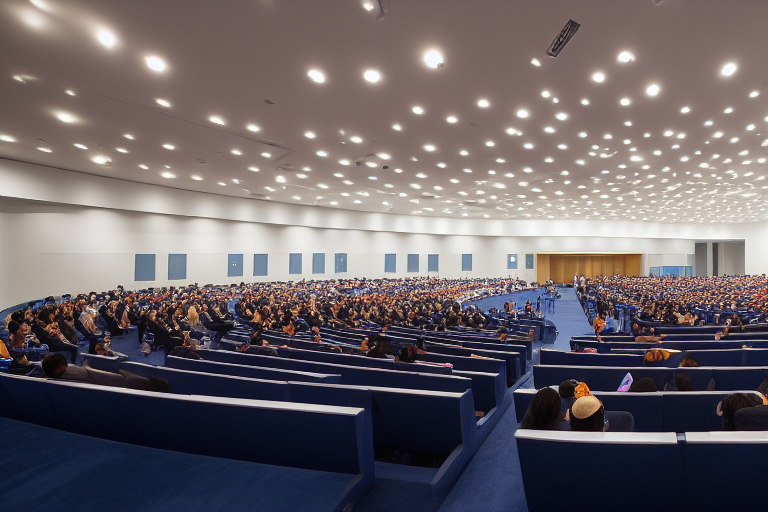
The national grand finals and award ceremony of the 2026 HarmonyOS Collegiate Innovation Competition recently concluded at Nanjing University, drawing nationwide attention as a milestone event for China’s software engineering education. Notably, the competition has officially been incorporated into the prestigious national ranking of regular university discipline competitions, institutionalizing HarmonyOS development as a core benchmark for engineering proficiency in higher education. Huawei Executive Director and Terminal BG CEO He Gang attended the ceremony to deliver keynote remarks and present awards to the winning student teams.
Unlike traditional academic software challenges that often yield theoretical proofs or isolated sandbox scripts, this year’s competition underscored a pragmatic philosophy: building applications that people can actually use in daily life. From campus life-management tools to accessible micro-utilities and cross-device collaborative utilities, the winning entries demonstrated an intuitive grasp of HarmonyOS’s distributed architecture. Rather than treating the platform as a mere alternative to Android or iOS, these young developers leveraged distributed capabilities, atomic services, and multi-screen seamless handoffs to solve genuine friction points in user experience.
Technical Analysis & Competitive Landscape
The strategic positioning of HarmonyOS relies heavily on establishing a self-sustaining developer ecosystem. In operating system history, technical superiority alone—regardless of kernel architecture or performance benchmarks—is insufficient for survival without a robust application marketplace. By embedding HarmonyOS challenges directly into the academic pipeline, Huawei is effectively pre-training an entire generation of developers on its ArkUI framework, ArkCompiler, and distributed software bus.
This approach stands in sharp contrast to western operating system ecosystems that grew organically over decades through iterative desktop-to-mobile transitions. HarmonyOS is pursuing an accelerated, hardware-software co-designed trajectory. The focus on ‘practical utility’ (用得上) addresses the historical software cold-start problem by encouraging lightweight, high-frequency utility apps that fill immediate gaps in the ecosystem. As Chinese enterprises accelerate software localization and independent IT infrastructure upgrades, developers fluent in native HarmonyOS distributed paradigms represent a highly specialized, highly sought-after talent pool.
Industry & Strategic Implications
The institutionalization of the HarmonyOS innovation contest signals a profound shift in how industry-academia partnerships function in China’s technology sector. Universities are no longer just producing generic computer science graduates; they are acting as specialized incubators aligned with national technological self-reliance initiatives. For enterprise IT leaders, this means the labor market will increasingly feature engineers who natively understand cross-device synergy rather than single-device siloed development.
Furthermore, this grassroots mobilization helps counter the psychological inertia of enterprise and consumer adoption. When young developers build real-world tools that solve authentic problems on HarmonyOS, they act as evangelists within their peer networks, universities, and early-career enterprises. This organic diffusion of technical literacy is vital for cementing HarmonyOS as a viable, third pillar in the global mobile and IoT operating system landscape.
“True ecosystem maturity is not measured by the lines of code in a kernel, but by the frequency with which an application solves a real human problem on a native architecture.”
Final Outlook
The success of the 2026 HarmonyOS Collegiate Innovation Competition points to a disciplined, long-term strategy by Huawei to anchor its software future in youth innovation. As these student developers graduate and enter the workforce, they bring with them an architectural mindset built entirely around distributed intelligence and native cross-device capabilities. While challenges remain in global developer acquisition and international ecosystem expansion, the domestic talent foundation is solidifying rapidly. The next phase of the HarmonyOS journey will depend on whether these practical student projects can scale into enterprise-grade commercial successes that redefine mobile and IoT interaction.
🚀 Custom Web Hosting & AI Automation Solutions
Need enterprise-grade web hosting, custom WordPress architecture, or automated workflow deployment for your business?



