
⚡ Executive Summary
- Core News: Genesis AI has secured an unprecedented $500 million Series A funding round to accelerate the development and deployment of its glove-wearing dexterous robotics systems.
- Key Metric/Data: The $500 million injection represents one of the largest early-stage capital raises in the history of robotics, signaling intense venture and institutional conviction in physical AI.
- Strategic Impact: By utilizing tactile-enhanced, glove-wearing end-effectors, Genesis AI is bridging the critical gap between rigid industrial automation and the fluid, human-like manipulation required in complex supply chains.
Developing News & Core Details
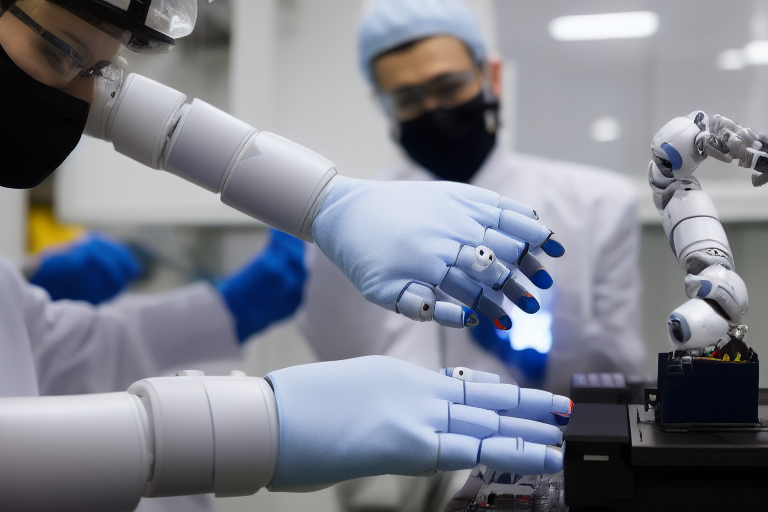
In a watershed moment for the physical AI and robotics sector, Genesis AI has formally announced the completion of a $500 million Series A financing round. The capital infusion is earmarked directly for scaling production, expanding engineering talent, and deploying its flagship glove-wearing dexterous robot fleet into enterprise production environments. Unlike traditional robotic manipulation paradigms that rely on rigid, task-specific mechanical grippers, Genesis AI’s architecture emphasizes human-inspired dexterity enabled by specialized tactile sensing gloves fitted over multi-articulated robotic hands.
This technical nuance allows the robots to interact with fragile, irregularly shaped, or deformable objects—surfaces that have historically stymied automated warehousing and manufacturing lines. The funding will build out a massive validation framework across global logistics hubs, allowing Genesis AI to transition from controlled laboratory testing to high-throughput commercial deployment. Industry analysts note that securing a half-billion-dollar Series A is an extreme anomaly in the current venture capital climate, illustrating that deep-tech hardware plays capable of solving foundational labor shortages can still command outsized liquidity.
Technical Analysis & Competitive Landscape
The core innovation underpinning Genesis AI’s valuation lies in its approach to end-effector design and tactile feedback control loops. Standard humanoid and industrial robots often struggle with the “dexterity tax”—the exponential computational and mechanical complexity required to manipulate objects with the nuance of human fingers. By outfitting its robotic systems with advanced glove-wearing architectures, Genesis AI bypasses several mechanical hurdles. These tactile gloves are embedded with high-density sensor arrays that transmit real-time pressure, friction, and slip data back to the neural control core at millisecond intervals.
Within the broader competitive landscape, Genesis AI finds itself positioned alongside well-funded humanoid developers like Figure, Agility Robotics, and Boston Dynamics, as well as specialised dexterous hand innovators like Shadow Robot Company. However, while many competitors focus heavily on bipedal locomotion, Genesis AI’s primary vector is hyper-dexterous manipulation, making its technology equally viable whether mounted on a mobile base, a stationary gantry, or a humanoid chassis. This modular versatility reduces integration friction for enterprise buyers who may not need bipedal walking capabilities, but urgently require human-level hand-eye coordination for assembly, sorting, and packaging.
Industry & Strategic Implications
The broader implications of a $500 million validation for dexterous robotics stretch far past industrial automation. As global supply chains face chronic labor deficits and rising wage pressures, the race to automate non-repetitive tasks has accelerated dramatically. Traditional automation required uniform parts and highly structured environments. Genesis AI’s tactile, glove-enabled approach is designed for unstructured, messy real-world environments—handling everything from textiles and fresh produce to delicate electronic components.
For enterprise IT and operations leaders, the emergence of commercially viable dexterous robots signals a paradigm shift in capital expenditure models. Robotics is rapidly evolving from a fixed-asset depreciating expense into a flexible, software-defined operational expenditure. Because Genesis AI’s systems learn via imitation and reinforcement learning pipelines, continuous software updates will expand the robots’ repertoire of skills long after initial deployment, fundamentally altering asset lifecycles in manufacturing and logistics.
“The defining bottleneck of modern automation is no longer mobility; it is manipulation. Until robots can handle the chaotic, tactile reality of the physical world with human-like dexterity, industrial autonomy remains bounded. Breakthroughs in sensor-rich, glove-enabled end-effectors are finally unlocking that frontier.”
Final Outlook
Genesis AI’s massive capital raise marks the beginning of a high-stakes race to commercialize human-level physical manipulation at scale. The coming 18 to 24 months will serve as a crucial stress test for the company, requiring it to prove that its glove-wearing robotic fleets can maintain uptime, reliability, and economic viability inside demanding enterprise facilities. If Genesis AI successfully translates its $500 million war chest into widespread operational deployments, it will not only rewrite the economics of global manufacturing and logistics, but also permanently redefine the boundary between human labor and machine capability.
⚡ Featured Enterprise & AI Infrastructure Picks
Building high-throughput AI pipelines or upgrading your workstation? Explore our curated cloud hosting, GPU workstations, and enterprise software stack.



