
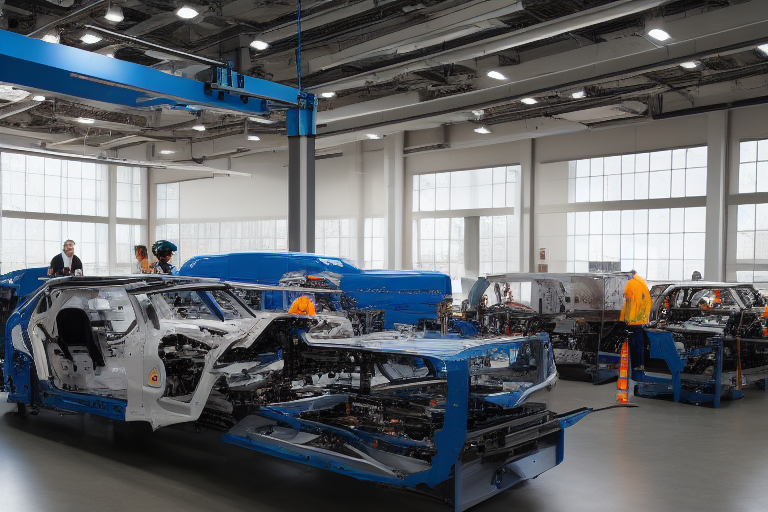
⚡ Executive Summary
- Core News: Tesla is committing €3 billion to expand its Berlin gigafactory, explicitly integrating the autonomous Cybercab into its European manufacturing roadmap.
- Key Metric/Data: A massive €3 billion capital injection aimed at transforming vehicle architecture production lines and scaling localized cell and assembly capacities.
- Strategic Impact: Accelerates Tesla’s regulatory and operational footprint in Europe, directly challenging legacy automakers on autonomous mobility and localized production economics.
Developing News & Core Details
Tesla’s strategic pivot toward autonomous ride-hailing has taken a definitive continental turn with the announcement of a multi-billion-euro expansion at Gigafactory Berlin. By earmarking €3 billion for facility upgrades, plant enlargement, and localized retooling, Elon Musk’s enterprise is making it unequivocally clear that the forthcoming Cybercab—Tesla’s purpose-built, steering-wheel-free robotaxi—will not be a U.S.-exclusive phenomenon. This capital expenditure represents one of the most significant single industrial investments in Europe’s electric vehicle and autonomous infrastructure sector to date.
The Berlin expansion goes far beyond mere assembly line duplication. To build vehicles designed from the ground up for autonomous fleets, Tesla must fundamentally alter its stamping, casting, and internal wiring architectures. The factory floor will see the introduction of next-generation unboxed manufacturing processes, minimizing footprint while maximizing throughput. Furthermore, the capital allocation covers critical environmental and logistical updates designed to satisfy stringent European Union regulatory frameworks, ensuring that Gigafactory Berlin can scale its output without running into the bureaucratic and ecological roadblocks that have historically dogged its expansion phases.
Technical Analysis & Competitive Landscape
From an architectural standpoint, the Cybercab diverges radically from Tesla’s legacy consumer fleet. By removing manual controls entirely, the vehicle relies exclusively on high-resolution camera arrays, localized neural networks running Tesla’s Full Self-Driving (FSD) software stack, and ultra-dense structural battery packs. Manufacturing these specialized vehicles requires a complete reimagining of the assembly workflow. Unlike traditional cars where the interior cabin is fitted out after the skeletal shell is painted and assembled, the Cybercab’s unboxed process constructs distinct vehicle modules concurrently before final snap-together integration.
This technical shift puts immense pressure on Europe’s legacy automotive giants—such as Volkswagen, BMW, and Mercedes-Benz—who are currently navigating a sluggish transition to software-defined vehicles. While traditional OEMs have heavily invested in premium assisted-driving features (ADAS), their underlying electronic architectures often remain fragmented across legacy suppliers. Tesla’s vertically integrated approach in Berlin allows it to iterate rapidly on hardware-software co-design, bypassing supply chain friction. However, the competitive battleground in Europe will not merely be fought in factories; it will hinge on regulatory approval. Securing type-approval for a steering-wheel-free vehicle across diverse EU member states remains a monumental hurdle that will test Tesla’s legal and governmental relations teams just as rigorously as its engineering prowess.
Industry & Strategic Implications
The decision to anchor the Cybercab production strategy in Germany carries profound implications for the European tech and automotive ecosystem. For regional suppliers, the €3 billion expansion triggers a race to adapt component manufacturing to Tesla’s hyper-lean, vertically integrated standards. Companies specializing in computer vision hardware, lightweight alloy casting, and power electronics will find themselves forced to innovate at an unprecedented pace to remain relevant in Tesla’s supply chain.
Moreover, the move alters the mobility-as-a-service (MaaS) landscape in Europe. While cities like London, Paris, and Berlin grapple with urban congestion and stringent emissions mandates, the introduction of a low-cost, dedicated autonomous fleet threatens to disrupt traditional public transit and ride-sharing models. If Tesla can successfully scale Cybercab production in Berlin, it introduces a deflationary cost curve to urban transportation, forcing municipal authorities to rethink urban planning, curb-space management, and public-private transit partnerships.
“Tesla’s multibillion-euro bet on Berlin proves that the future of mobility is not just electric—it is fundamentally autonomous, algorithmic, and decoupled from traditional vehicle ownership models.”
Final Outlook
Tesla’s €3 billion Berlin gigafactory expansion marks a watershed moment for the company’s European ambitions. By binding its manufacturing future to the Cybercab, Tesla is betting that the continent is ready to leapfrog traditional car-ownership paradigms in favor of autonomous networks. Execution, however, remains the ultimate arbiter of success. Navigating Germany’s rigorous labor laws, environmental compliance checks, and the EU’s cautious stance on unsupervised AI deployment will test the limits of Tesla’s corporate agility. If successful, the Berlin facility will not only cement Tesla’s dominance in the global EV market but also pioneer the blueprint for how autonomous infrastructure is manufactured and deployed in the 21st century.
⚡ Featured Enterprise & AI Infrastructure Picks
Building high-throughput AI pipelines or upgrading your workstation? Explore our curated cloud hosting, GPU workstations, and enterprise software stack.



